As Google becomes agent-driven, SEO must make you selectable
Google I/O 2026 marks a clear shift: Search is moving from classic results pages to AI answers, agentic workflows and generative interfaces. For businesses, this means that visibility is no longer just about rankings. It's about being chosen as the source AI systems trust.
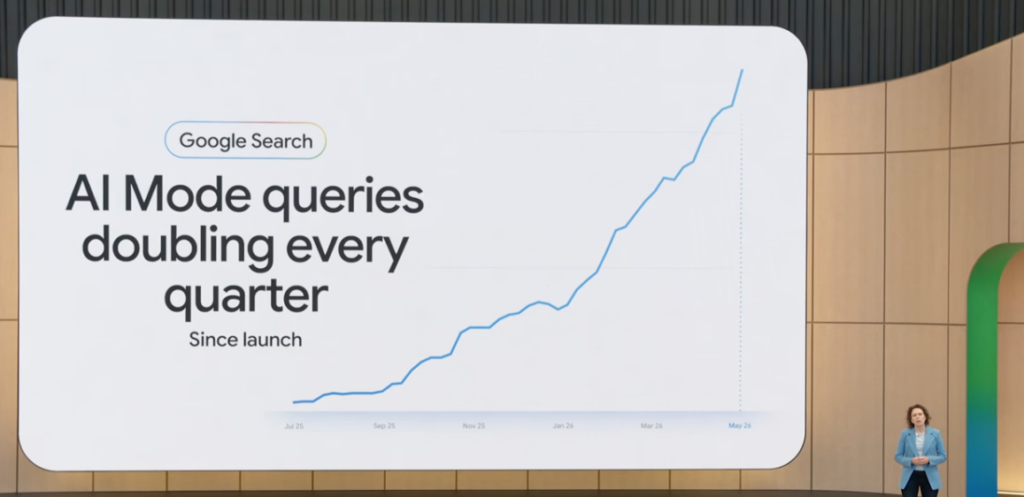
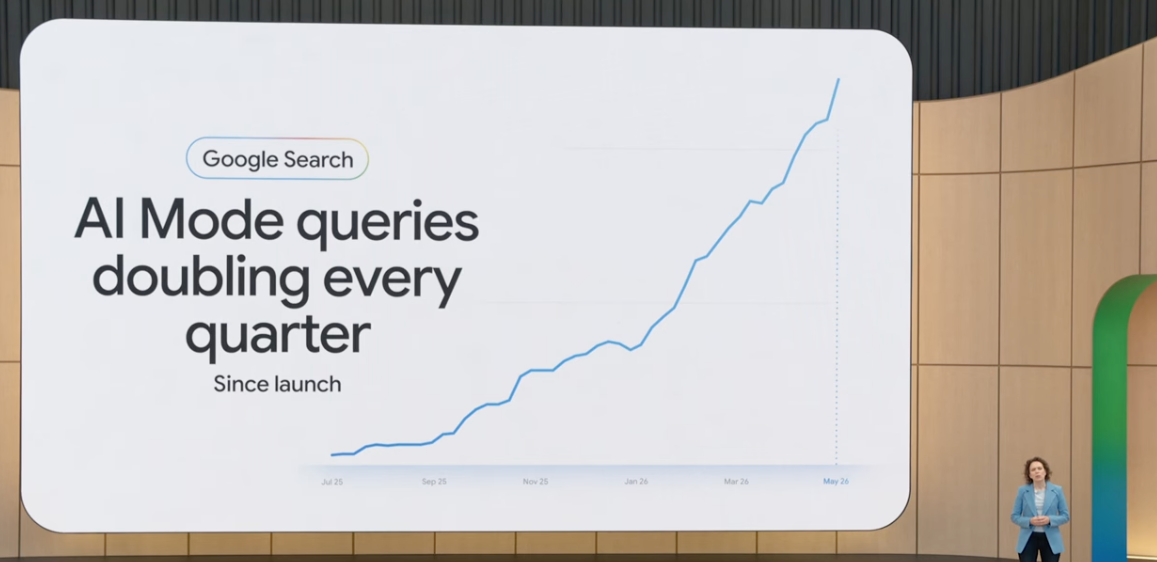
In a nutshell: Google states that AI Overviews now has over 2.5 billion monthly active users and that AI Mode has passed 1 billion monthly active users in one year.[1] At the same time, Google introduces Search Agents, Information Agents and Generative UI, where AI can monitor the web, gather answers and create interfaces in real-time.[2] Therefore, SEO in 2026 should not only be measured by rankings and traffic, but also by whether the company is mentioned, cited and recommended in AI answers.
It's tempting to describe Google I/O 2026 as just another technology event. It isn't. When Google itself refers to Search as a more ongoing conversation and launches agents that can work in the background, it changes the way customers find, evaluate and select suppliers. Classic search isn't going away, but it's being supplemented by a decision-making process where AI increasingly filters information before the customer lands on a website.
For marketing and management teams, the key takeaway is simple: it's not enough to be visible to the search engine. You need to be understandable, credible and relevant enough for AI systems to use you as a source when putting together an answer.
What Google advertised and why it matters
The key Search news from Google I/O 2026 points in the same direction. Search will become more multimodal, more conversational and more action-oriented. AI Mode will have a stronger model, AI Overviews can flow into AI Mode, and Information Agents can monitor topics, sources and changes on behalf of the user.[2]
| Google news | What does it change? | SEO consistency |
|---|---|---|
| AI Overviews | The user gets an AI-generated answer directly in the search result. | The company must be cited as a credible source, not just ranked as a link. |
| AI Mode | Search becomes a conversation where the user asks follow-up questions and goes deeper into the research. | Content must match multiple formulations, intentions and decision questions. |
| Information Agents | AI agents can monitor the network around the clock and provide synthesized updates. | Timeliness, source coverage and external authority become more important because AI needs to validate the brand continuously. |
| Generative UI | Search can create tables, graphs, simulations and mini-apps directly in the answer. | Structured data, clear explanations and machine understandable content are becoming more important. |
What's new is not that Google is using AI. What is new is that AI is increasingly becoming the framework for research, comparison and action. When the answer is created in the interface, the battle for visibility also becomes a battle to be among the sources the answer is based on.
From locations to eligibility
Classic SEO has long been about achieving strong rankings on the searches that drive relevant traffic. That's still important. But AI search changes the success criteria. In AI answers, there is rarely room for ten equal organic results. There is one synthesized answer, a handful of sources and often a recommended direction.
That's why companies should work with a broader view of visibility. It's not just about being found. It's whether AI understands who you are, what you offer, which audiences you serve and why you should stand out above the competition.
The new SEO question
Before: Where do we rank on Google?
Now: Are we mentioned, quoted and recommended when AI answers customer questions?
Pillar and query set: What do you want to be the answer to?
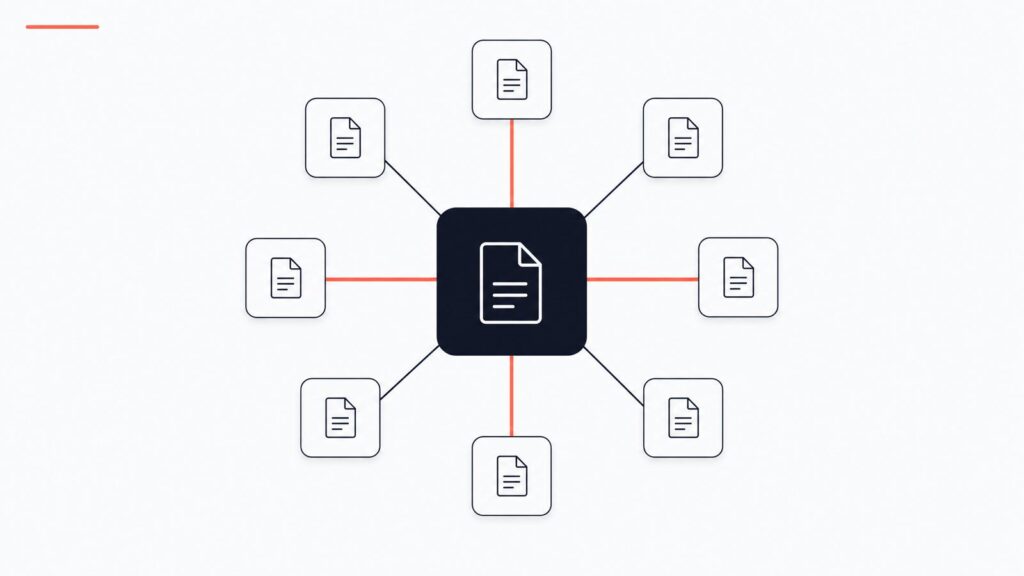
An AI SEO strategy should start with the customer decision journey. AI systems do not only work with short keywords. They encounter long, concrete and situational questions where the user is often closer to a decision than in classic information search. Therefore, the strategy should be built around a clear pillar topic and a set of supporting customer questions.
| Structure | Example of an example | Purpose |
|---|---|---|
| Main kw / pillar | AI SEO | Defines the overall topic the company wants to own in AI answers and classic search. |
| Query | How do we become visible in Google AI Overviews? | Match the customer's specific problem and make the content easier to use in AI responses. |
| Query | What sources does ChatGPT use when recommending suppliers? | Shifts the focus from your own pages to the overall source base around the brand. |
| Query | How do we measure Share of Voice in AI responses? | Make AI SEO operational and possible to prioritize based on data. |
| Query | How do external mentions affect our visibility in AI? | Connects content, digital PR, link building and authority in one unified strategy. |
What AI agents choose is rarely random
When AI systems put together a response, they don't just evaluate one page in isolation. They try to understand the bigger picture of the topic, the brand and the sources. This means that strong landing pages are still necessary, but rarely sufficient on their own. Companies need to prove relevance through their own website, structured data, up-to-date content, external mentions and consistent signals across the market.
This is where AI SEO differs from a narrow ranking discipline. The goal is not just to drive more traffic. The goal is to make the company a source that AI can understand, validate and use when a potential customer asks for advice, comparison or recommendation.
| Area of interest | What needs to be in place? | Why does it matter in AI search? |
|---|---|---|
| Own website | Clear performance pages, articles, cases, FAQs, comparison pages and up-to-date facts. | AI must be able to find precise answers and understand the company's expertise. |
| Structure and data | Logical information architecture, schema markup, clear author and expertise signals. | Structure makes content easier to interpret, cite and connect with the user's questions. |
| External sources | Media coverage, industry sources, partner profiles, analytics, relevant directories and credible references. | AI uses external signals to validate whether the brand has real authority. |
| Timeliness | Continuously update content, cases, data, prices, services and documentation. | Information Agents and AI responses will increasingly reward sources that are fresh and consistent. |
AI SEO requires both analysis and execution
The practical mistake is to make AI SEO a content project alone. Multiple articles may be necessary, but they won't solve the problem if the company doesn't simultaneously measure its AI visibility, understand competitors' source bases, and prioritize the queries that have the greatest commercial impact.
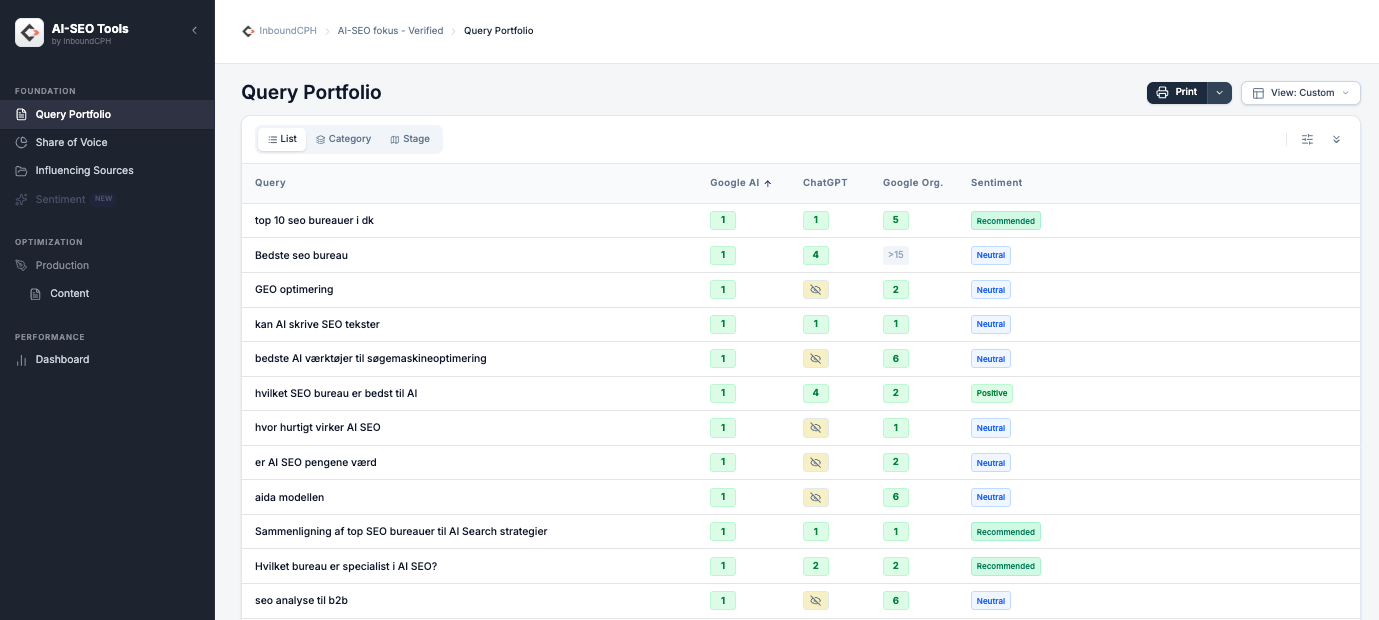
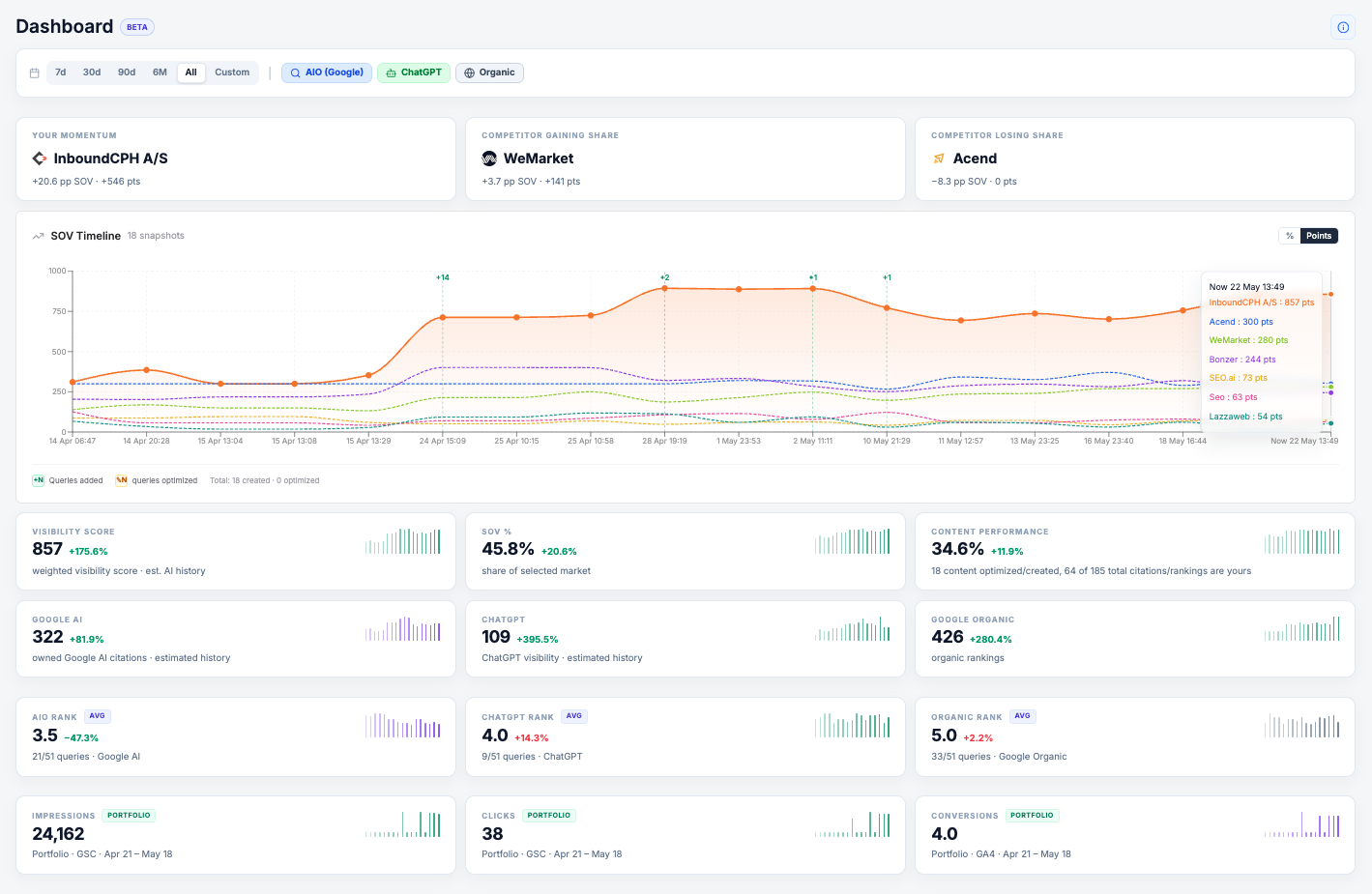
InboundCPH's AI SEO Tools platform is designed to do just that. The platform gathers Query Portfolio, Share of Voice, citations, Content Gaps and performance signals so that work can be managed based on data. It is also built for managed SEO: AI scales research, analysis and prioritization, while specialists manage strategy, quality, commercial assessment and execution.
From whitepaper to action plan
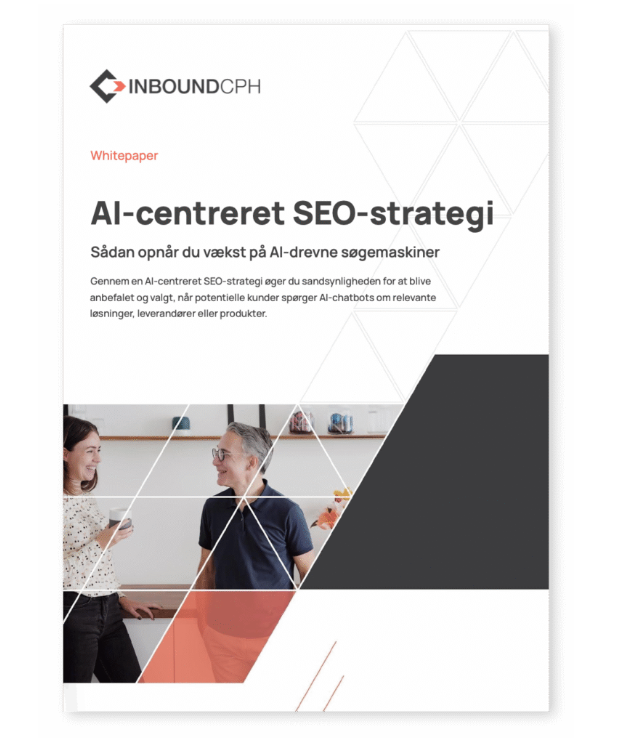
We have gathered our approach in the whitepaper AI-centric SEO strategy. Here we review how AI is changing the customer journey, why visibility into AI answers is becoming business-critical, and how companies can work systematically to get selected in ChatGPT, Gemini, Perplexity, Google AI Overviews and other AI-powered search experiences.
The whitepaper is relevant for companies that are already investing in SEO, but want to ensure that their efforts also work in a search reality where customers increasingly get recommendations, comparisons and decision support directly from AI.
Establish baseline
Measure how often your brand is mentioned in AI answers to key customer questions and compare it to the competitors customers typically rate you against.
Prioritize Query Portfolio
Build efforts around specific queries from the customer journey, not just classic keywords. This provides a more precise link between visibility and business value.
Strengthen the source base
Work with your own website, verifiable external rankings and independent external mentions so AI can validate your relevance from multiple sources.
Execute continuously
AI SEO is not a one-time exercise. Visibility, citations and competition change, and strategy needs to be adjusted based on proven developments.
What should businesses do now?
The most important thing is not to react in panic to every new Google ad. The most important thing is to get clarity on where the company stands today. What questions will customers ask AI? Who is mentioned in the answers? What sources are being used? How strong is your brand compared to competitors? And what gaps in content, authority and documentation are preventing you from being chosen?
Once those questions are answered, AI SEO can be prioritized as a strategic growth effort. Not as an experiment alongside SEO, but as the natural extension of modern search engine optimization.
FAQ about Google I/O 2026 and AI SEO
Is classic SEO still important?
The answer is yes. Classic SEO is still the foundation for visibility, authority and technical understandability. But AI SEO expands the work because companies must also be mentioned, cited and recommended in AI answers.
What is the difference between SEO and AI SEO?
SEO is traditionally about gaining visibility in organic search results. AI SEO is about making the company selectable in AI answers, where systems like ChatGPT, Google AI Overviews, Gemini and Perplexity compile answers from multiple sources.
How do you measure visibility in AI responses?
It should be measured on multiple levels: whether the brand is mentioned, whether it is cited as a source, which URLs are used, how visibility develops over time and how the company stands relative to competitors on key customer questions.
Why do external sources matter more in AI SEO?
AI systems must be able to validate claims. If a company only describes itself on its own website, the source base is weaker than if the same position is supported by industry sources, analytics, partner profiles, media coverage and relevant citations.
What is InboundCPH's AI SEO Tools platform?
It is InboundCPH's proprietary platform for analyzing and prioritizing AI SEO. The platform is used for Query Portfolios, Share of Voice, citations, Content Gaps and performance development, among other things, so work can be managed based on data and specialist assessment.
Get selected in the new search reality
Google I/O 2026 shows that AI search is not a future scenario. It's already part of the customer journey. If you want to understand how your brand ranks in AI answers today and what it takes to boost your visibility, we can help with a data-driven AI SEO analysis in InboundCPH's AI SEO Tools platform.
Start with our whitepaper: Download AI-centric SEO strategy.
To see how your brand performs in ChatGPT, Google AI Overviews, Gemini and Perplexity, you can read more about InboundCPH's AI SEO solution or get in touch for a review of the platform.
Sources
[1] Google, Sundar Pichai: I/O 2026: Welcome to the agentic Gemini era, May 19, 2026.
[2] Google Search, Elizabeth Reid: A new era for AI Search, May 19, 2026.
[3] Google: 100 things we announced at I/O 2026, May 20, 2026.
[4] Chrome Developers: 15 updates from Google I/O 2026: Powering the agentic web with new capabilities, tools, and features in Chrome, May 19, 2026.
[5] InboundCPH: Whitepaper: AI-centric SEO.