How AI Search Engines Select and Cite Their Sources
An AI search engine operates on the same principles as traditional search: Content must be crawled, indexed, and deemed authoritative before it can be considered. This is described in the section on what AI SEO is, and it dispels some of the mystery. An AI assistant doesn’t find sources through some secret channel, but rather relies on the same infrastructure from Google and builds a layer on top of it.
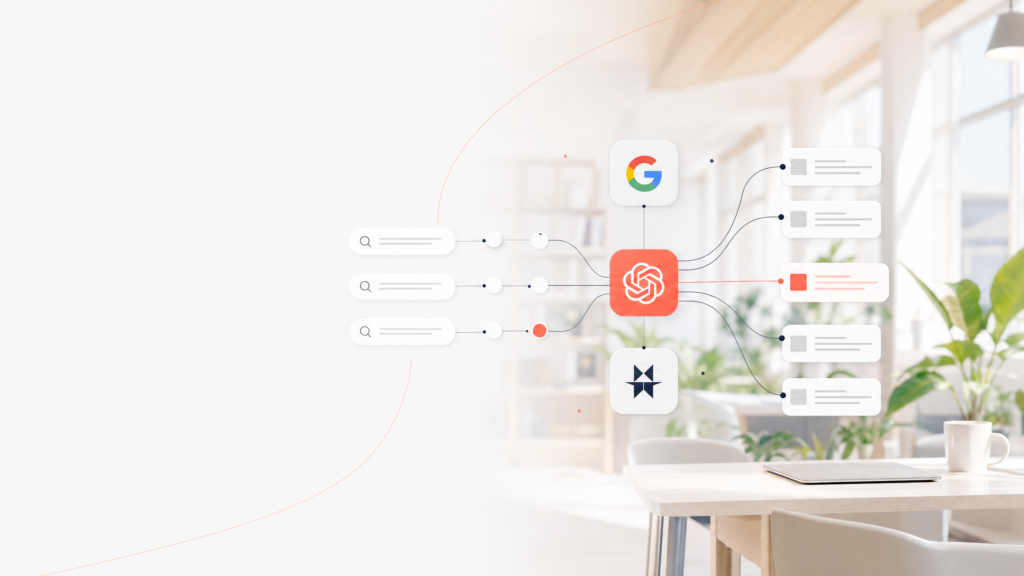
This layer is called Retrieval-Augmented Generation, often abbreviated as RAG. The assistant doesn’t just respond based on what the model learned during training. When you ask a question, it retrieves relevant sources, reads them, and formulates its answer based on them. The sources it chooses to cite are visible to the user. The rest are not mentioned.
Two factors determine what appears in the results. The first is the model’s own knowledge base, shaped during training, where established, editorial, and reference-based sources make up the bulk of the data. This explains why an AI assistant treats these types of sources as credible. The second is the ongoing retrieval process, in which fresh and relevant content is incorporated into the response itself.
One pattern is worth noting right here: What others write about you elsewhere on the web seems to carry a lot of weight when an AI search evaluates who is worth citing. We’ll come back to the figure behind this in the section on authority.
Platform by platform: ChatGPT, Perplexity, Gemini, and Google AI Mode
Visibility in AI assistants isn’t a single game, but several. ChatGPT, Perplexity, Gemini, and Google AI Mode draw on different sources and prioritize different things, and a page that’s frequently cited in one place may be absent in another. The advice is therefore simple: Prioritize based on where your customers are actually asking their questions. The following is based on the prompts we regularly run for Danish customers across the four platforms.
ChatGPT Search
It's about becoming a source that the model trusts. ChatGPT tends to rely on authoritative sources and quotable passages.
Freshness and Sources
It places a high priority on updated content and company profiles. Discipline regarding timing and maintenance is crucial.
The Basics of SEO
Tightly integrated with Google Search. A solid, classic SEO foundation actually counts twice: in the search results and in the AI layer.
Across all four platforms, one pattern stands out: It’s usually others talking about you who drive the citations, not your own pages. Reddit and Wikipedia are among the most frequently cited sources overall.
GEO and AEO vs. Traditional SEO: Complementary, Not a Showdown
A common misconception is that AI search renders traditional SEO efforts obsolete. It does not. SEO for AI search is built on the same foundation as traditional search engine optimization, and Google itself has stated that visibility in AI Overviews and AI Mode is based on the same principles as regular search. A website that cannot be crawled, structured, or understood by a search engine will not be cited by an AI assistant either. The foundation should not be discarded, but expanded.
StudyA peer-reviewed study by Princeton and others (Aggarwal et al., KDD 2024) shows that specific GEO techniques—such as citing sources and adding statistics—can significantly boost a page’s visibility in AI responses.
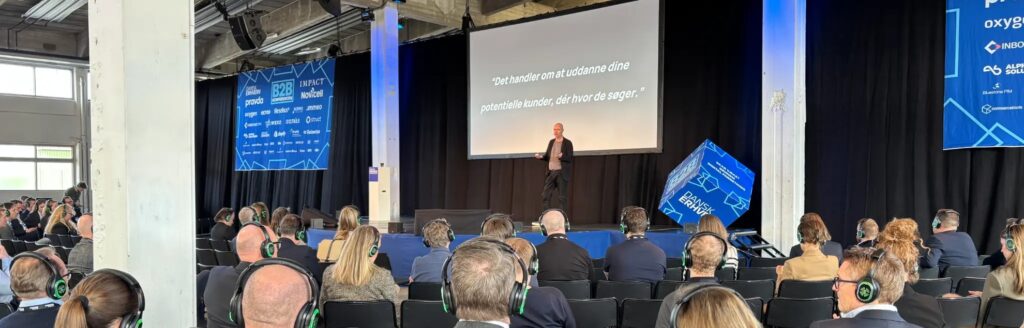
“You can rank number 1 on Google, but still be invisible to ChatGPT. GEO is about being chosen, not just found.”
— Henning Madsen, CEO, InboundCPH
Classic SEO makes you discoverable. GEO and AEO increase the likelihood that you’ll also be chosen when the answer is generated by a machine.
Structured Data as a Lever for Visibility
Structured data is code that you add to your website to tell machines what the content is and who created it. A search engine and an AI assistant can read your text faster and more accurately with explicit signals indicating that this is an article, this is the author, and this is the publisher. The easier the content is for machines to understand, the easier it is to reference. That’s the core of AI search optimization: You’re not only making the content good for people, but also readable by the systems that determine what gets included in the search results.
Three types are most effective. Article markup (schema.org/Article) tells the machine that a page contains editorial content with a headline, body text, and publication date. Organization and Person build sender credibility: They describe the company behind the content and link a named author to the content using a `sameAs` field that points to the author’s other profiles. For a machine assessing a source’s credibility, a clear and verifiable author is a meaningful signal.
FAQPage (schema.org/FAQPage) also exists, but there’s a nuance worth noting here. Google has announced that FAQ rich results will no longer appear in Google Search as of May 7, 2026. This doesn’t make the FAQ schema useless, but don’t include it just to try to get a rich result that’s no longer there. Use it only when an FAQ is actually useful to the reader on the page.
One principle ties it all together: The schema must match the visible content. Never mark up anything that isn’t on the page. Incorrect markup undermines the very trust that determines whether a machine will choose you. The implementation itself belongs in In-Depth Technical SEO.
Content structure being cited: "Answer-first" and standalone passages
An AI assistant almost never reads your page the way a human does, scrolling from top to bottom. It looks for passages it can extract and reproduce directly. That’s why AI search optimization is just as much about how the content is structured as it is about what it says. A page can have the right answer and still be overlooked because the answer is buried under three paragraphs of introduction.
The most well-documented strategy is to make the conclusions citable. The peer-reviewed study by Princeton et al. (Aggarwal et al., KDD 2024, 10,000 queries) found that citing sources and adding statistics and quotes can boost a page’s visibility in AI responses by up to 40 percent. This is no guarantee for your page, but it offers a clear direction: Content that is itself accurate, well-sourced, and concrete is retrieved more often.
- Write "Reply first": So the direct answer appears at the top of a passage, and the elaboration follows below.
- Short paragraphs: Keep the paragraphs short and self-contained so that each one can stand on its own.
- Question Headings: Write the headlines as the questions your target audience actually asks.
- Specific conclusions: Support your conclusions with specific figures and sources.
The easiest way to understand the model is to see it in action. This page is structured according to it: The “Answer” block at the top provides the short answer before the detailed explanation, the headings are questions, and the FAQ section compiles the specific answers into separate paragraphs. A page about AI search visibility should, of course, follow its own advice.
Authority, brand mentions, and E-E-A-T as a basis for citations
When an AI assistant is about to respond, it doesn’t randomly choose whom to cite. It relies on sources that already appear credible because the models are trained on content where those same sources recur in relevant contexts. Here, your AI search visibility is shaped by something other than technology and structure—namely, the trust your brand has built outside of your own website.
Google has articulated this trust through the E-E-A-T framework: Experience, Expertise, Authoritativeness, and Trust. It describes whether content is written by someone with real experience and documented expertise, from a source with professional credibility, in a way that the reader can trust. The framework isn’t a button you can press, but a metric that Google’s evaluators use, and it closely aligns with the way AI models select sources. In practice, this means “people-first” content: content written for people with a specific need, not for an algorithm. Google describes this approach in its guidelines on helpful content and in his Search Quality Rater Guidelines.
One of the clearest patterns in the data suggests that mentions outside your own website carry significant weight. In an analysis of 75,000 brands from May 2025, Ahrefs found that off-site brand mentions correlate about three times more strongly with visibility in AI responses than traditional backlinks. This is a correlation, not a cause, but it’s a clue as to where you should focus your attention. The sources the models most frequently draw from are, after all, generally places where others talk about you—communities and reference works—rather than channels you control yourself. Citation potential is therefore at least as much about coverage in trade media and reference works as it is about your own websites.
That kind of exposure is built up over time. We purchase high-quality links with genuine editorial value from media outlets with a real readership, and we never recommend link farming, PBN networks, or bulk link purchases, because those tactics do not build authority. We explore the authority track in more depth in our work with link building.
Technical Requirements: Can AI bots even read your website?
All of the above depends on one thing: that search engine crawlers can access and index your website. If access isn’t enabled, even the best content structure and strongest authority will be ineffective, because no crawler will be able to reach the page.
The first place to look is robots.txt, the file that tells crawlers what they are allowed to access on a website. Google describes in its documentation how the file controls crawl access (robots.txt Introduction from Google Search Central). AI assistants' crawlers can be allowed or blocked in the same way. OpenAI's crawler, GPTBot, can be explicitly allowed or blocked in robots.txt, as OpenAI documents in its bot overview. The point is simple: If you block AI crawlers, they won’t be able to index your content either. This happens more often than you might think, typically in a standard setup that has never been reviewed for AI visibility.
Next, the content must be readable once the crawler has accessed the page. Here, the difference between server-side rendering and client-side rendering is crucial. With server-side rendering, the finished content is delivered directly from the server, while client-side rendering first builds it using JavaScript in the user’s browser. Content that only exists after the JavaScript runs risks being invisible to a crawler that doesn’t execute scripts—and thus to the AI assistant that relies on it. A well-structured sitemap helps crawlers find all the content. One final detail is worth mentioning: llms.txt. This is an emerging standard that some websites are experimenting with to direct AI models toward selected content. It’s a voluntary convention, not an official requirement from Google or AI platforms, so use it only if you have a clear strategy for doing so.
Frequently asked questions about AI Search
How does AI Search differ from classic SEO?
Classic SEO is about ranking high in Google’s organic results by optimizing keywords, building backlinks, and ensuring technical factors are in order. AI Search is about being cited by AI models in their summarized responses. This requires a different content structure (question-based answer blocks), different signals (E-E-A-T, semantic depth, brand mentions), and different metrics (Share of Voice rather than CTR). The two disciplines are not mutually exclusive. They must run in parallel and reinforce each other when combined correctly.
Can the impact of AI Search be measured?
Yes, and with greater precision than many people realize. We measure Share of Voice by systematically feeding a representative sample of relevant queries into AI models and tracking how often your brand is mentioned. We also track referral traffic from AI platforms in Google Analytics, and we link the data to your Google Ads and Search Console to assess the commercial value of each campaign. You’ll receive data-driven reports where you can see every query and every response behind the numbers, allowing you to track progress over time.
Is it too late to start AI Search now?
No, quite the opposite. We’re still in the early stages, where competition for AI visibility is significantly lower than in traditional SEO. The companies that establish themselves as credible sources in AI models’ responses now are building a position that will be difficult to displace later. The window of opportunity is gradually closing, and it is the first movers who will dominate their category in AI Search in the years to come.
Which AI platforms should we focus on?
Prioritization depends on your audience and industry, but the top four in 2026 are ChatGPT (largest user base), Google AI Overviews (biggest impact on classic search), Perplexity (research-heavy audience) and Claude (enterprise users). Copilot and Gemini are also growing. We recommend measuring Share of Voice across all relevant platforms, but prioritize your efforts where your customers are.
What is Share of Voice in AI responses?
Share of Voice expresses the proportion of relevant AI answers that mention your brand. If 100 potential customers ask ChatGPT for recommendations within your category and your brand is mentioned in 35 of the responses, you have a Share of Voice of 35%. This is the most direct indicator of your AI visibility and correlates strongly with commercial impact.
How soon can we see results?
Typically, the first measurable changes occur within 4–8 weeks, and a solid baseline improvement is achieved within 3 months. Quick wins in the form of Schema Markup, E-E-A-T optimization, and content structuring can yield rapid results, while building authority and semantic depth is a longer-term effort.
What does it cost to work with AI Search?
The investment depends on your level of ambition, market competition, and the number of business areas. Most partnerships begin with a limited pilot program starting at 35,000 DKK as a one-time investment, so you can see the concrete results before committing to an ongoing partnership. If you then choose a fully integrated program, it typically starts at 25,000 DKK per month and scales from there.
Is AI Search relevant for both B2B and B2C?
Both. In B2B, where complex customer journeys and research are heavily weighted, AI Search is particularly important and we often see higher conversion rates from AI-powered B2B traffic than from classic search. In B2C, AI visibility is increasingly influencing purchase decisions, especially for considered purchases (electronics, financial products, travel). The principle is the same in both cases: if your brand is not mentioned in AI responses, you are effectively invisible in a growing part of the decision-making process.
How do we ensure correct brand mentions in AI responses?
This requires a combination of structured onsite content (Schema Markup, consistent brand language, named authors) and coordinated offsite presence (digital PR, consistent mentions across niches and industries). If the AI encounters conflicting or unclear information about your brand, you risk incorrect or diluted mentions. We work systematically to map and correct the sources the AI models draw on so that your brand is consistently represented correctly.
What if we already work with another SEO agency?
It works well to combine. AI Search efforts can run in parallel with your existing SEO collaboration as long as the tasks are clearly delineated. We often find that our AI Search efforts strengthen your classic SEO performance as a positive side effect, because the same authority and content signals are rewarded by both Google and the AI models.
Ready to be recommended by AI?
Start with a Share of Voice audit, or contact us directly for a no-obligation discussion about your AI Search potential.