What is Topical Authority?
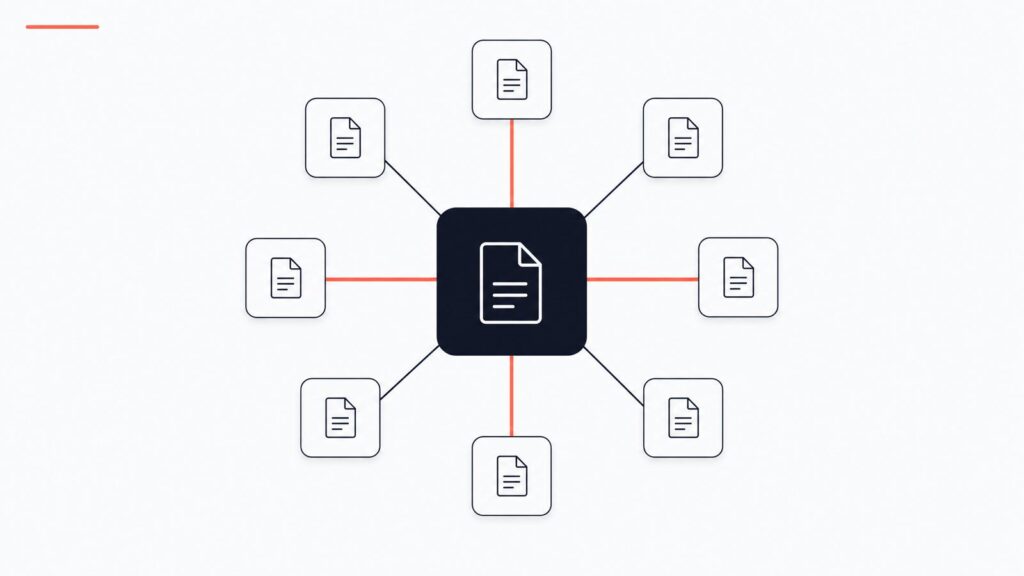
Topical Authority is the trust a search engine places in a website when the site covers a specific topic in both depth and breadth. The concept describes how well a website covers a subject area as a whole, rather than just how well a single page answers a specific search query. Authority is built over time through focus, a structure of pillar and cluster pages, internal linking, and subject-matter depth in the content.
Important. It’s worth making this clear right away: Topical authority is not an official Google score or a single measurable metric that you can look up. There is no “topical authority score” that Google has officially disclosed. The term is an umbrella term for how a topic is covered, and how relevance and semantic signals are assessed across a website; it’s used in the field of SEO to describe a context, not a single number.
The reason why comprehensive coverage matters is practical. A website that covers a topic thoroughly from multiple angles sends more relevant signals about the topic than a site with a single, isolated page. When related pages are interconnected and link to one another, it becomes clearer to the search engine what the site is about and how thoroughly the topic is covered. In other words, breadth and depth make a website easier to understand and evaluate as a credible source in its field.
Topical Authority refers to the depth of coverage on a specific topic and should not be confused with Domain Authority, which describes a domain’s overall strength as measured from the outside. The difference between the two is discussed below. For a broader overview of what SEO is and how its various elements are interconnected, please refer to the dedicated article on the subject.
Topical authority vs. domain authority
The most important distinction regarding this concept is the difference between topical authority and domain authority. The two terms sound similar, but they describe different things and are calculated in different ways.
Topical authority
- Built from the inside out through content
- Covers a specific topic in depth
- Driven by structure and internal linking
Topical authority is built from within. It increases when a website covers a specific topic thoroughly through comprehensive coverage, a well-thought-out structure, and internal linking between related pages. It is the site’s own content and the way that content is organized that builds topic authority in a particular field.
Domain Authority
- It is built from the outside using links from external domains—hence the name.
- Wide diversity across relevant articles and domains
- Third-party metrics (e.g., Moz DA / Ahrefs DR)
Domain authority, on the other hand, is a broader measure of strength for the entire domain, and it is often driven by external links from other websites. Whereas Topic Authority indicates the depth of expertise on a single topic, Domain Authority aims to reflect the domain’s overall influence across multiple topics.
Here’s a crucial clarification: The domain authority metrics you most often encounter come from third-party tools, not from Google. Moz’s Domain Authority (DA) and Ahrefs’ Domain Rating (DR) are two well-known examples. Both are metrics calculated by the tools themselves, which estimate a domain’s strength based on factors such as its backlink profile, and they are neither official Google scores nor anything the search engine itself uses or verifies. They are useful as benchmarks, but they are calculated by the tools that provide them.
The key point is that these two factors can pull in opposite directions. A website can have high topic authority on a specific, narrow topic because it covers that exact field thoroughly, without having a high domain metric. Conversely, a domain can have a high DA or DR due to numerous external links without having strong topic authority on a specific, narrow topic. In short, the two concepts answer different questions, and one cannot be inferred from the other. For the external, link-driven side of the picture, we refer you to the article on link building.
How to Build Topical Authority
Building topical authority is a concrete process involving content and structure. Topical authority grows when a website covers its core topic in a coherent manner, and in practice, it rests on four elements that you can work on systematically. Together, they strengthen the conditions that enable a search engine to understand and evaluate your coverage of the topic.
Pillar Page
A comprehensive, in-depth main page on your core topic that provides an overview of the subject and serves as a focal point for the other pages.
Support and Cluster Pages
In-depth pages that each thoroughly cover and explore a specific subtopic, while the main page only touches on it in general terms.
Internal linking
The cluster pages link to the pillar page and to each other, so the content is interconnected as a topic cluster model. This signals to the search engine that the site covers the topic in a coherent manner, rather than through isolated individual pages.
Broad and in-depth coverage of topics
"Breadth" means that you cover the relevant subtopics a reader would expect within the field. "Depth" means that each subtopic is addressed thoroughly rather than superficially.
When the four elements work together, a structure emerges in which pillar pages and cluster pages support each other. The pillar page provides the overview, the cluster pages provide the depth, and internal linking ties it all together into a cohesive whole that’s easier to understand as comprehensive coverage of the topic. It is this interplay between breadth, depth, and structure that, over time, can build topic authority in a given field.
It’s worth emphasizing what this method is not. Topical authority is the result of ongoing work on content and structure, and it’s not something that can be guaranteed or achieved overnight. A well-developed topic focus strengthens the conditions for the content to be understood and deemed relevant, but it is a prerequisite, not a guarantee of rankings. Topic authority is closely linked to the strategic work within an overall SEO strategy, where coverage of a topic is one of the strategic goals.
Why is topical authority important?
Topical authority is worth building because it’s linked to two things that search engines and AI engines already prioritize: in-depth, helpful coverage of a topic and subject-matter credibility. When a website covers a specific topic thoroughly and comprehensively, a search engine has more points of reference for assessing the content’s relevance, and this applies across related searches within that topic—not just a single page.
In its own guidelines, Google emphasizes content that is helpful, reliable, and written with genuine professional insight—summarized by the acronym E-E-A-T (Experience, Expertise, Authoritativeness, Trustworthiness). This is evident in Google’s guidelines for helpful, reliable content. There is no publicly available “topical authority score” that you can check using a tool. The point is a matter of principle: Strong coverage of a topic and documented expertise strengthen the likelihood that the content will be deemed relevant when someone searches for that topic.
The same applies when the answer does not come from a traditional search result, but from an AI engine. Authoritative sources with comprehensive, coherent content are more likely to be highlighted and cited by AI assistants such as ChatGPT, Perplexity, and Google AI Overviews. This is part of what AI SEO is and what GEO is works with, and it is an extension of traditional subject authority, not a guarantee of citation.
Frequently asked questions
What is topical authority?
Topical authority refers to a website covering a specific topic in such depth and breadth that search engines can consider it an authoritative source on that topic. It is not an official Google score, but rather the result of comprehensive coverage of the subject and professional credibility.
What is the difference between topical authority and domain authority?
Topical authority refers to a website’s internal, topic-specific depth and coverage. Domain authority, on the other hand, is a metric from Moz that assesses a domain’s overall external link strength, and Ahrefs’ equivalent is called Domain Rating (DR). The latter two are third-party metrics from SEO tools, not Google scores.
How do you build topical authority?
Subject authority is typically built by compiling content on a pillar page about the core topic, supported by cluster pages on individual subtopics, all linked together through internal linking. The goal is to cover the topic in both breadth and depth. There is no fixed timeframe or guarantee of results associated with this work.
What are topic clusters and pillar pages?
A pillar page is a comprehensive main page that covers a core topic. A topic cluster consists of the pillar page and the cluster pages that address subtopics, all linked together via internal links. This structure signals to search engines that the website covers the topic in a cohesive manner.
How long does it take to build topical authority?
It depends on how competitive the topic is, the website’s starting point, and the scope of the effort. There is no set number of weeks or months. Building topic authority is an ongoing process that strengthens the foundation for visibility over time.
Is topical authority related to link building?
Subject authority is primarily built internally through content and structure, while link building builds external authority through references from other websites. The two complement each other but are distinct strategies, each with its own purpose.
Does topical authority matter for AI visibility?
Yes, that seems to be the case. Authoritative sources with comprehensive content are more likely to be cited by AI engines and AI assistants because they are easier to find, understand, and trust. This improves the chances of being cited, but doesn’t guarantee it. You can read more in the article about what GEO is.
Topical authority is built through comprehensive coverage of a topic, a well-thought-out structure, and internal linking, and it strengthens the foundation for visibility in both traditional search results and AI-generated answers. If you’d like to read more, we have dedicated articles on what SEO is, SEO strategy, and link building.
Do you want to cover your topic in depth?
We help you translate topic authority into a concrete pillar and cluster structure that boosts your visibility in both traditional search results and AI-powered answers. Get an overview of your topic coverage.
Based on Google's guidelines for helpful, reliable, and people-first content: Google Search Central — Creating helpful, reliable, people-first content.