What Google's guide actually tells us
In June 2026, Google updated its official guidelines on optimizing websites for generative AI features in search, including AI Overviews and AI Mode. The message is more subdued than many AEO and GEO providers have suggested: the features that generate AI responses rely on Google’s existing ranking and quality systems. SEO has not, therefore, been replaced by a new discipline, but rather expanded. For a marketing manager, this means that investing in solid content and a technically sound platform remains the foundation, while some of the “hacks” currently circulating can be set aside. Our work with AI SEO is based precisely on that distinction.
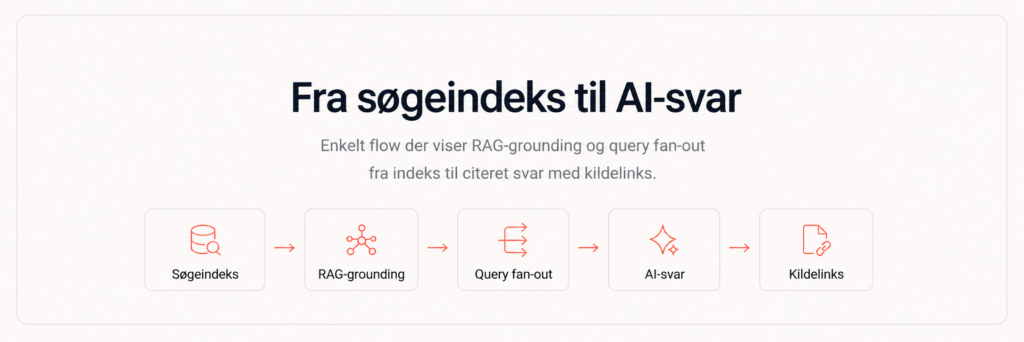
The Two Mechanisms Behind AI Responses
Google points to two technical mechanisms that determine when a page is included in an AI response. Understanding them helps you prioritize your efforts correctly rather than chasing signals that don’t make a difference.
Retrieval-Augmented Generation
The AI response is retrieved from Google's search index via the standard ranking systems and includes clickable source links. If your page is not indexed and relevant, it is not eligible for citation.
Parallel Partial Searches
The model breaks down a single question into several related searches simultaneously. Broad, well-structured content that naturally covers related questions therefore provides multiple paths to the answer.
The point is that visibility in AI-generated results is determined in the same place as traditional visibility: in the index. That’s also why we treat organic SEO and AI visibility as two outcomes of the same effort rather than two separate projects.
The four pillars that Google itself highlights
The guide summarizes these efforts into a few principles that apply regardless of whether the goal is a traditional ranking or a spot in an AI response.
Create valuable, non-generic content
Google values a unique perspective, firsthand experience, and expert knowledge that goes beyond general knowledge. According to the guide, recycled content—the kind a model could have produced themselves—is the least effective path to long-term visibility.
Maintain a clear technical structure
A page must be crawlable, indexable, and displayable with a snippet to even be considered. A good page experience, proper handling of JavaScript, and the reduction of duplicate content are the same requirements that technical SEO has always demanded.
Write for people, not for the model
Well-organized content with clear paragraphs and headings helps both readers and AI. Relevant images and videos expand the platforms on which a website can appear.
Enhance local and commercial details
Product data via Merchant Center and an updated Google Business Profile make the business visible in search results where AI includes products and local results.
What Google Says You Can Skip
A significant portion of the guide is devoted to debunking myths. This is where the gap with some AEO and GEO consulting is greatest. The list below is not a call to abandon existing best practices, but rather to refrain from investing in measures that have no proven effect on Google Search.
| “Hacks” That Are Often Recommended | Google's Position |
|---|---|
| llms.txt and other AI-specific files | Not necessary. The file is not processed in any special way. |
| “Chunking” content into small pieces | It's not a requirement. Google understands multiple topics on the same page. |
| Rewriting text specifically for AI | Unnecessary. The model understands synonyms and context. |
| Chasing fake “mentions” | Low impact. The spam filters block it. |
| Overemphasis on structured data | Not required for AI responses, but still useful for rich results. |
For a company with limited time, this is a sensible priority: resources yield a greater return when focused on content and technology rather than AI-specific markup. This aligns with the approach we describe in our A Complete Guide to AI-Driven SEO.
So what do “AEO” and “GEO” mean?
Google recognizes these concepts but views them as part of SEO rather than separate from it. From Google Search’s perspective, optimizing for generative AI is the same as optimizing for the search experience. This does not diminish the value of a concept such as GEO (Generative Engine Optimization), but it shifts the focus: the work is about the same quality and structural principles, not about a separate toolkit. The value therefore depends on how the principles are implemented on your own platform, not on what acronym is used to describe the initiative.
Agentic experiences are the next layer
The guide briefly mentions that AI agents are increasingly able to perform tasks on behalf of users, from comparing products to carrying out actions. Browser agents parse a site through rendering, the DOM, and the accessibility tree, and new protocols such as the Universal Commerce Protocol are on the horizon. For most companies, this is not yet an urgent priority, but it’s worth keeping an eye on because a technically sound and accessible site is also the one that’s easiest for an agent to navigate. We’re following these developments closely as part of our work with AI Search.
Our take
Google’s guide confirms what we’re working toward: AI visibility isn’t achieved through tricks, but through the same cross-channel discipline as organic SEO, combined with data-driven prioritization of which questions actually need to be answered. Our approach is human-guided and enterprise-oriented, because that is where the quality and credibility that AI systems value are actually created.
Frequently asked questions
Is SEO still relevant when the answers come from AI?
Yes. Google’s AI features rely on the same ranking and quality systems as regular search, so solid SEO remains the foundation for appearing in AI answers.
Do I need an llms.txt file to be recognized by the AI?
No. Google states that llms.txt and other AI-specific files are not required and are not processed separately. Focusing on content and technical structure yields better results.
Are AEO and GEO different from SEO?
From Google Search's perspective, it is the same discipline. The concepts describe a focus on AI visibility, but the work is based on the same quality and structural principles as SEO.
Should I break my content down into small “chunks” for AI?
No. Google understands multiple topics on the same page. The page length should be tailored to the target audience and the topic, not to an assumption about how the algorithm reads it.
What should a company prioritize first?
Unique, expert-driven content and a crawlable, indexable platform. It depends on the starting point, but these two factors carry more weight than AI-specific markup.
Should your AI visibility be based on Google's own principles?
We’ll assess where you stand with AI responses today and identify which questions are worth addressing. Book a no-obligation review of your AI visibility.
Source: Google Search Central — Optimizing Your Website for Generative AI Features on Google Search.