What is the difference between SEO and AI-SEO?
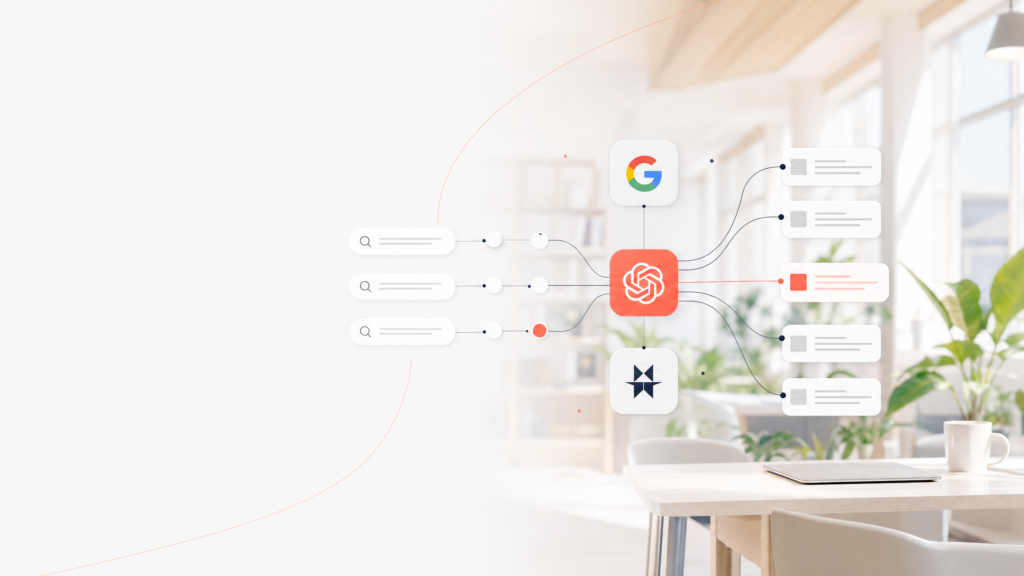
Traditional search engine optimization targets Google search results, which often include about ten links. AI-SEO targets the answers an AI assistant provides when a user asks a question. The goal is for the content to be highlighted, cited, and recommended within the answer itself.
AI-SEO can be understood in two ways. The first:
(a) involves using AI tools to create and optimize standard SEO—that is, having a language model write drafts, find keywords, or fix technical issues.
The second one:
(b) involves making content visible in the AI assistant's own responses.
This page discusses the last meaning (b).
The AI assistants in question are ChatGPT, Perplexity, and Google AI Overviews.
When a user asks one of them for advice, the assistant compiles a response based on the sources it deems most relevant and reliable.
AI-SEO is built on the same foundation as traditional SEO and expands upon it with a focus on becoming one of the sources included in the summary.
AI-SEO combines several underlying factors, including GEO and technical accessibility for AI bots, which are discussed individually below.
AI SEO vs. Traditional SEO
AI-SEO and traditional SEO are built on the same foundation but each has its own goal. Both disciplines require that content be technically accessible, substantively authoritative, and backed by strong E-E-A-T signals. That is the common ground. The difference lies in what the effort is aimed at: a position in a list of search results or a spot within the answer generated by an AI engine.
The table below compares the two disciplines:
| Classic SEO | AI-SEO | |
|---|---|---|
| Goal | Ranking in search results | Visibility and Citations in AI Engine Responses |
| Output | A list of links that the user can click to navigate to | A source cited or referenced in the AI response |
| Measurement | Rankings and Click-Through Rate (CTR) | Mention and Citation Rates in AI Responses |
| Foundation | Technical accessibility, authoritative content, E-E-A-T | The same foundation as classic SEO |
What they have in common carries more weight. A website that isn’t technically accessible or professionally credible won’t perform well in either organic search results or AI-generated answers. Here, the difference between manual SEO and AI SEO is smaller than it initially appears: They rely on many of the same signals, and it rarely makes sense to choose one over the other.
That is why AI-SEO is an extension of traditional SEO, not a replacement for it. AI features such as Google AI Overviews are part of Google’s standard search behavior, as Google documents in Google Search Central's documentation on AI features. The work that has already been done in search engine optimization remains a prerequisite. For a comprehensive overview of what SEO is and the elements it covers, please refer to the dedicated article.
The Disciplines of AI-SEO
AI-SEO is an umbrella term. It encompasses a range of disciplines, each of which focuses on making content visible and citable when a user asks an AI engine a question instead of clicking through search results. These aren’t new inventions in and of themselves, but rather familiar SEO techniques adapted to a new outcome. Here are the five that fall under this umbrella:
GEO (Generative Engine Optimization)
The discipline that optimizes content so that generative AI engines like ChatGPT and Perplexity cite it in their responses. How these AI engines actually select and cite sources is discussed in the dedicated article on What GEO Is.
Visibility in AI Overviews
To be featured in the AI-generated answers that Google displays at the top of the search results. Results from these AI features are included in the standard search behavior that Google describes in Google Search Central's documentation on AI features.
Technical Accessibility for AI Bots
Content must be crawlable and renderable by the bots that retrieve it before it can be cited at all. This is part of the foundation covered under technical SEO.
Citable content
Clear, standalone answers and definitions that an AI engine can extract from context and reproduce directly. OpenAI describes, how responses in ChatGPT Search are supplemented with links to relevant sources from the web.
Documented Authority
E-E-A-T and external sources that support the credibility of the content on the page. Here, the work overlaps with link building.
The five disciplines draw on the same foundation that good SEO has always been built upon: content that is easy to access, easy to understand, and trustworthy. The difference lies in what the effort is aimed at. AI engines do not select sources in the same way, and the mechanics behind that selection vary from engine to engine. That part belongs on the page about What GEO Is, which discusses the citation mechanism in detail.
Why AI-SEO Matters Now
An increasing portion of a buyer’s research no longer begins with a traditional search result, but with a conversation with an AI assistant. Users ask questions, compare options, and narrow down their list before visiting a single supplier’s website. When an AI assistant summarizes a topic and references a few sources, those are the sources that are considered early on. If your content isn’t cited, you’re not part of the conversation the buyer is having before they decide who to look into further.
The fact that it’s possible to achieve visibility here isn’t just theory. Azets, a Nordic consulting and accounting firm, ranks number one in Google’s AI Overviews for the keyword “Interim CFO” with a 20.4 percent share. This is a business-critical keyword and a concrete example of how a Danish B2B company can achieve documented visibility in an AI-generated result. This example is not a guarantee of the same result, but it shows that visibility is real and measurable when the right conditions are in place.
And “prerequisites” is the right word. AI-SEO strengthens the prerequisites for being cited; it does not guarantee that an AI assistant will recommend you. The field is new, and behavior changes as AI engines evolve. That’s why the point is fundamental: As AI assistants conduct more research, it becomes more valuable to be a source they can find and cite. AI-SEO is part of an overall SEO strategy, not a discipline in its own right.
How to Use AI for SEO
AI-SEO adapts traditional search engine optimization to a world where AI engines read, evaluate, and cite content. In practice, the work revolves around the same three principles that underpin good SEO. None of them guarantees citation, but together they strengthen the conditions for your content to be found, understood, and used.
Citable content
Clear, independent answers that AI engines can extract from context and reproduce directly.
Technical Accessibility
The content must be crawlable and renderable by AI bots before it can be cited. This is part of the technical foundation you’re familiar with from technical SEO.
Documented Authority
E-E-A-T and external sources that support the credibility of what you write. This is where AI search engine optimization overlaps with the work in link building.
AI visibility can be measured on an ongoing basis. One method is to track a fixed set of business-critical prompts over time and see where you and your competitors are mentioned, as well as which sources the models cite. This provides insight into whether your efforts are making a difference, rather than just guessing.
These three tracks are not a new discipline with its own set of rules. They are based on the same fundamental principle: content that is easy to understand, easy to access, and trustworthy. If you’d like to read more, the guide can be found at AI Search Visibility an in-depth look at how you are found and cited in practice, and answer engine optimization covers the broader field of answer engines. This work is also closely linked to an overall SEO strategy and to the work in a AI Agency.
Frequently asked questions
What is AI SEO?
AI-SEO is an umbrella term for the work of making content visible and citable in AI engines such as ChatGPT, Google AI Overviews, Perplexity, Claude, and Gemini. It is based on the same principles as traditional SEO and focuses on ensuring that content can be retrieved and cited within an AI-generated response.
Does "AI-SEO" mean using AI to do SEO?
The term is used in two senses. Here, we use it in a broad sense to refer to making content visible and citable in AI engines’ responses. Using AI tools to produce or analyze content is one tool among many—not the entire discipline.
What is the difference between AI-SEO and traditional SEO?
Traditional SEO aims for a ranking in search results, while AI-SEO aims for visibility and citations in AI-generated responses. The two share much of the same foundation, because content that is technically accessible and factually credible is a prerequisite in both cases.
Is AI SEO better than regular SEO?
It’s not an either/or situation. AI-SEO is an extension, not a replacement. A website that performs well in search engines is often better positioned to be cited by AI as well, because the two disciplines draw on the same signals.
What is the difference between AI-SEO and GEO?
AI-SEO is the Danish umbrella term for visibility in AI engines. GEO (Generative Engine Optimization) is one discipline under that umbrella, aimed specifically at being cited in generative AI responses. You can read more about what GEO is in the dedicated article.
Which AI engines are relevant for AI SEO?
Among the relevant ones are ChatGPT, Google AI Overviews, Perplexity, Gemini, and Claude. This list is not exhaustive, and the landscape is constantly changing as more AI engines retrieve and cite sources.
AI-SEO is built on the same foundation as good SEO, and the source that is easy to find, understand, and trust is the one that gets cited when buyers ask an AI engine for advice. If you’d like to read more about related concepts, we have dedicated articles on what SEO is, What GEO Is, SEO strategy and technical SEO.
Lorem ipsum dolor sit amet, consectetur adipiscing elit. Ut elit tellus, luctus nec ullamcorper mattis, pulvinar dapibus leo.