The New Reality: AI as the Ultimate Gatekeeper
For many years, marketing departments have been optimizing based on the same premise: If we target the right keywords and build enough links, we’ll land on page one, and then the customer will click. That premise is undergoing dramatic change with the rollout of Google AI Overviews (AIO), ChatGPT Search, and Perplexity.
The customer journey has been condensed. Users no longer want to piece together the puzzle themselves by reading five different articles and manually comparing features. They expect AI to do the work and provide a synthesized, objective answer. For businesses, this means that AI has stepped in as a new, intelligent gatekeeper between your brand and your potential customers. If the algorithm doesn’t understand your product or doesn’t consider you an authority, you’ll be filtered out long before the customer even sees a link.
While traditional SEO has historically rewarded keyword density and technical speed, it requires AI-powered SEO a significantly more nuanced strategy. The AI models place far greater emphasis on information depth, E-E-A-T (Experience, Expertise, Authoritativeness, Trustworthiness), and external trust signals.
From Visibility to Recommendation
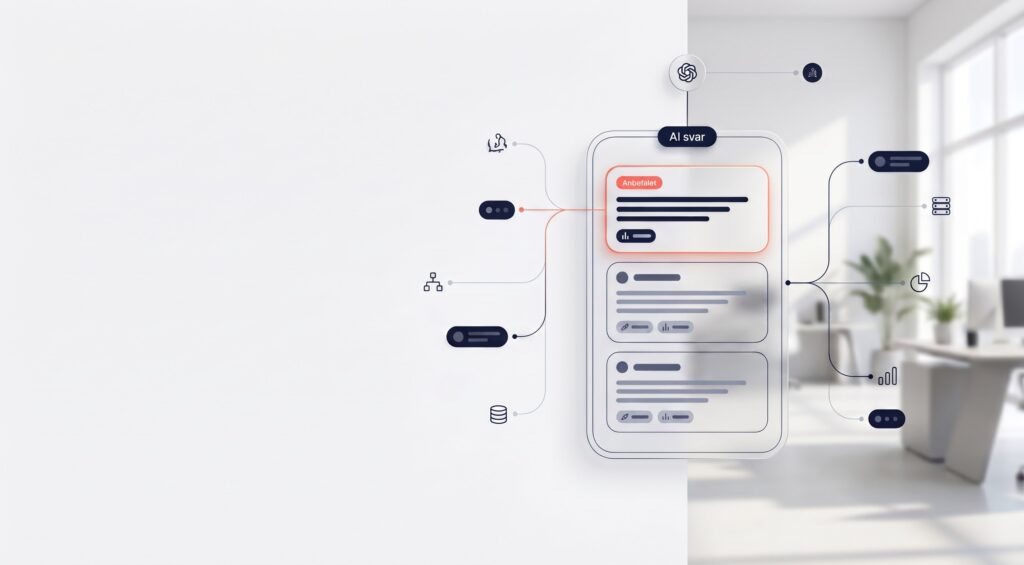
The goal is no longer simply to be found. The goal is to be selected, cited, and recommended as the primary source when the customer turns to the AI for advice at the crucial moments of the customer journey.
The Customer Journey in the AI Era: Information Phase vs. Shortlist
To succeed with AI-SEO optimization, the strategy must reflect the way customers actually use AI. In complex B2B sales and major consumer purchases, the customer journey can generally be divided into two critical phases where AI dictates the outcome.
| Stage in the customer journey | User Behavior | The Role of AI | Your Strategic Goals |
|---|---|---|---|
| 1. The Information Phase | Asks broad, exploratory questions (e.g., “What are the benefits of a cloud-based CRM?”). | Serves as an advisor and instructor. Compiles definitions and explains concepts. | Being cited as a source. Requires in-depth, objective knowledge (pillar-fanning) and structured data. |
| 2. The Decision-Making Phase (Shortlist) | Asks specific, business-related questions (e.g., “Compare the Best CRM Systems for Manufacturing Companies”). | Acts as the buyer's assistant. Provides a final recommendation and a specific shortlist of brands. | Being named on the shortlist. This requires significant brand authority and offsite mentions on external, trusted sites. |
During the information phase, you establish yourselves as thought leaders through onsite content. But it’s during the decision-making phase that things really heat up. When the buyer asks for a recommendation, the AI doesn’t provide a list of links—it delivers a ready-made shortlist. If your brand isn’t mentioned here, you don’t exist in the buyer’s considerations. This is exactly where many established companies today are losing market share without even realizing it.
A brand can rank highly in organic search results and still be virtually invisible when a customer asks an AI. That’s why we measure Share of Voice separately for AI responses.
The 3 Pillars of Effective AI-Driven SEO Optimization
3These disciplines form the foundation of effective AI-SEO optimization. To achieve visibility and be cited in AI responses, the strategy must be built on a foundation that addresses both the machine’s need for structured data and its reliance on external trust signals. At InboundCPH, we work with a combination of three key disciplines.
Onsite GEO (Generative Engine Optimization)
GEO is about structuring your own content specifically for AI models. Language models do not “read” like humans; they parse structures. This involves using easy-to-read tables, clear definitions, bullet lists, and direct expert statements. When content is formatted to answer complex questions accurately, the likelihood of being quoted in the AI response Significant. It's about serving the answer to the algorithm on a silver platter, without any unnecessary marketing fluff.
Offsite Content and PR
AI models are largely trained on Sources of Influence – review sites, industry media, Reddit, and independent blogs. These serve as “testimonials.” What other authoritative sources say about your brand carries extreme weight when the AI generates a shortlist during the decision-making phase. Even if you have the world’s best landing page, the AI will hesitate to recommend you if no one else in the industry is talking about you. Digital PR and placing expert quotes on external domains that the AI already trusts are therefore a crucial—yet often overlooked—part of AI SEO.
Technical Foundation and Bot Access
If the AI can’t read your site, you don’t exist in its worldview. Many companies unknowingly block AI crawlers via robots.txt in an attempt to protect their data. A modern Technical SEO Setup ensures that crawlers such as Googlebot-Extended and ChatGPT-User have access to the content they are allowed to use for training.
- Allow access for AI crawlers in robots.txt
- Implement
llms.txtto guide language models toward machine-readable information - Use advanced structured data (Schema) as a translator for the bot
“We went from being invisible in AI responses to being cited in our most important search results within a quarter. This has generated leads we otherwise would never have seen.”
How We Use a Data-Driven Approach with Our AI-SEO Platform
Implementing an AI-SEO strategy requires a methodical approach in which data drives the effort. Many people are groping in the dark when it comes to AI searches because traditional SEO tools cannot measure what ChatGPT or Google AIO tell users.
At InboundCPH, we have built a dedicated AI-SEO platform that enables us to work systematically on visibility in AI responses. The platform simulates customer queries in real time and extracts data directly from the AI models’ responses.
Measuring Share of Voice
We identify the questions your customers are asking. The platform simulates these searches and measures your “Share of Voice.” This provides an accurate picture of how often you’re cited, whether you’re on the AI’s shortlist, and how you’re performing compared to your competitors.
Identifying Gaps
Once we know what the AI responds with, we identify “Content Gaps”—areas where you’re falling short. At the same time, the platform generates a list of your industry’s “Top Influencing Sources,” so we can target your offsite PR efforts precisely where they’ll make the biggest impact.
Human-in-the-loop content
Purely AI-generated text gets lost in the crowd. We combine the data-driven structure of our platform with your subject matter experts’ unique knowledge, real-world customer cases, and well-reasoned opinions. It is this human depth that the AI rewards with citations.
B2B software made it onto the AI shortlist
A Danish software company was not featured when buyers asked AI to compare solutions. Through targeted onsite GEO and placement on the industry’s Top Influencing Sources, the brand became a regular part of the AI’s recommendations for the most commercially important searches.
Rank on page one
- Keywords and Links
- Clicks are the goal
- Contest for 10 spots
Be quoted in the reply
- Authority and Publicity
- The goal is to earn a recommendation
- Competition for a single shortlist
Frequently asked questions
How do you optimize SEO for AI?
You optimize for AI by combining onsite GEO principles (depth of information, clear structure, lists, and tables) with a strong offsite strategy that ensures mentions on external platforms (Influencing Sources) that the AI trusts. At the same time, the technical foundation—including bot access and llms.txt—must be in place.
Is traditional SEO dead by 2026?
No, traditional SEO isn’t dead, but it has evolved. The technical foundation, speed, and domain authority are still critical prerequisites for even being indexed. The difference is that content strategy must now also accommodate AI-generated responses, which means that the hybrid model—where you optimize for both traditional search engines and AI agents—is the new standard for visibility.
What is the difference between SEO and AI-SEO optimization?
Traditional SEO focuses primarily on ranking high among the traditional blue links on a search results page. AI-SEO optimization, on the other hand, focuses on being selected and cited as the primary source in the direct, generated answer—and, not least, securing a spot on the “shortlist” that the AI presents to the user during the crucial decision-making phase.
Get an AI-powered SEO analysis of your business
Would you like to know how visible your company is in AI responses compared to your competitors? With our AI-SEO platform, we map out your Share of Voice, identify content gaps, and develop a strategy for how you can be chosen when customers ask the AI.