What are ChatGPT Ads?
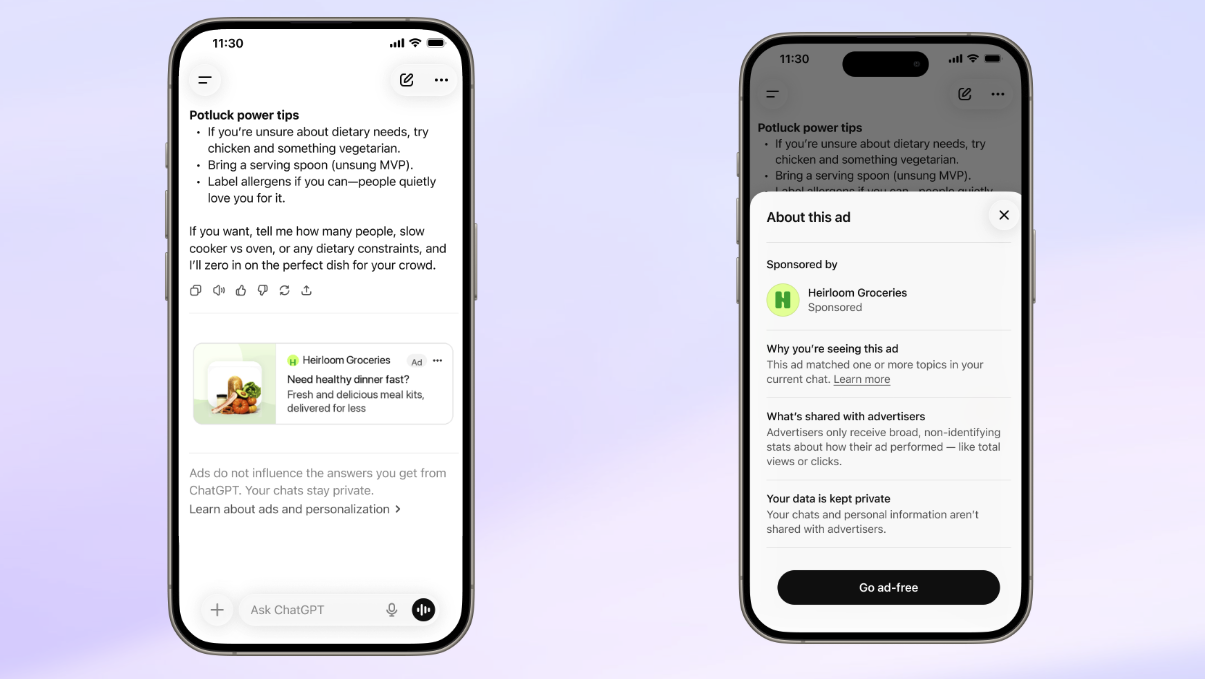
ChatGPT Ads is OpenAI's ad format, in which paid ads appear below relevant ChatGPT responses, clearly marked as sponsored. An ad consists of the advertiser's name, a favicon, a headline, a description, an image, and a link to a landing page.[2]
The ads are separate from the response itself. OpenAI states that advertisers cannot influence, rank, or alter ChatGPT’s responses. Paid visibility in ChatGPT purchases an ad placement, not a recommendation from ChatGPT.
ChatGPT Ads differ from traditional search advertising in their conversational context: The user has often described their goal, requirements, and constraints in coherent sentences before the ad is displayed. That context can make the ad’s targeting more precise than a brief search query. However, ChatGPT Ads are still in beta, and Danish advertisers do not yet have a solid local data foundation for measuring effectiveness or scalability.
Ads below relevant answers
ChatGPT Ads appear during a relevant conversation and consist of the advertiser's name, favicon, headline, description, image, and a link to a landing page.[2]
Free and Go, never under 18
Ads in ChatGPT are shown to Free and Go subscribers. Plus, Pro, Business, Enterprise, and Edu plans are ad-free, and users under 18 do not see ads.[3]
Context Over Personalization
Personalized ads are not available in the EEA and Switzerland during the initial phase. In Denmark, ad delivery is based on the context of the conversation, language, approximate location, and the relevance of the ad.[3]
Sign up via OpenAI Ads Manager
The advertiser account is created in OpenAI Ads Manager and requires business information, verification, a billing profile, and a payment method before campaigns can be served.[4]
When was ChatGPT Ads launched in Denmark?
ChatGPT Ads were announced for Denmark on August 18, 2026, and the rollout began during the week of August 24, 2026, along with 30 other European markets. Danish companies can now purchase ad placements on ChatGPT for the first time.[1]
Access is being rolled out in phases. Advertiser accounts must be verified and approved in OpenAI Ads Manager before campaigns can be served, and OpenAI processes applications on an ongoing basis.[4] ChatGPT Ads is in beta, so category access, formats, and pricing are subject to change in the coming months.
How do you target ads in ChatGPT?
Targeting in ChatGPT Ads is based on the context of the conversation and the advertiser’s so-called context hints, not through keywords, bids, or match types. Context hints describe the conversations, topics, and decision-making situations in which the ad is relevant. Context hints do not function as exact-match keywords and do not guarantee that the ad will appear in specific conversations.[2]
Personalized ads are not available in the first phase in the European Economic Area or Switzerland. In Denmark, therefore, delivery depends primarily on the context of the current conversation, the language, the approximate location, and the relevance of the ad. OpenAI assesses relevance based on context hints, along with the ad’s text and landing page.[3]
Users manage their own ad data
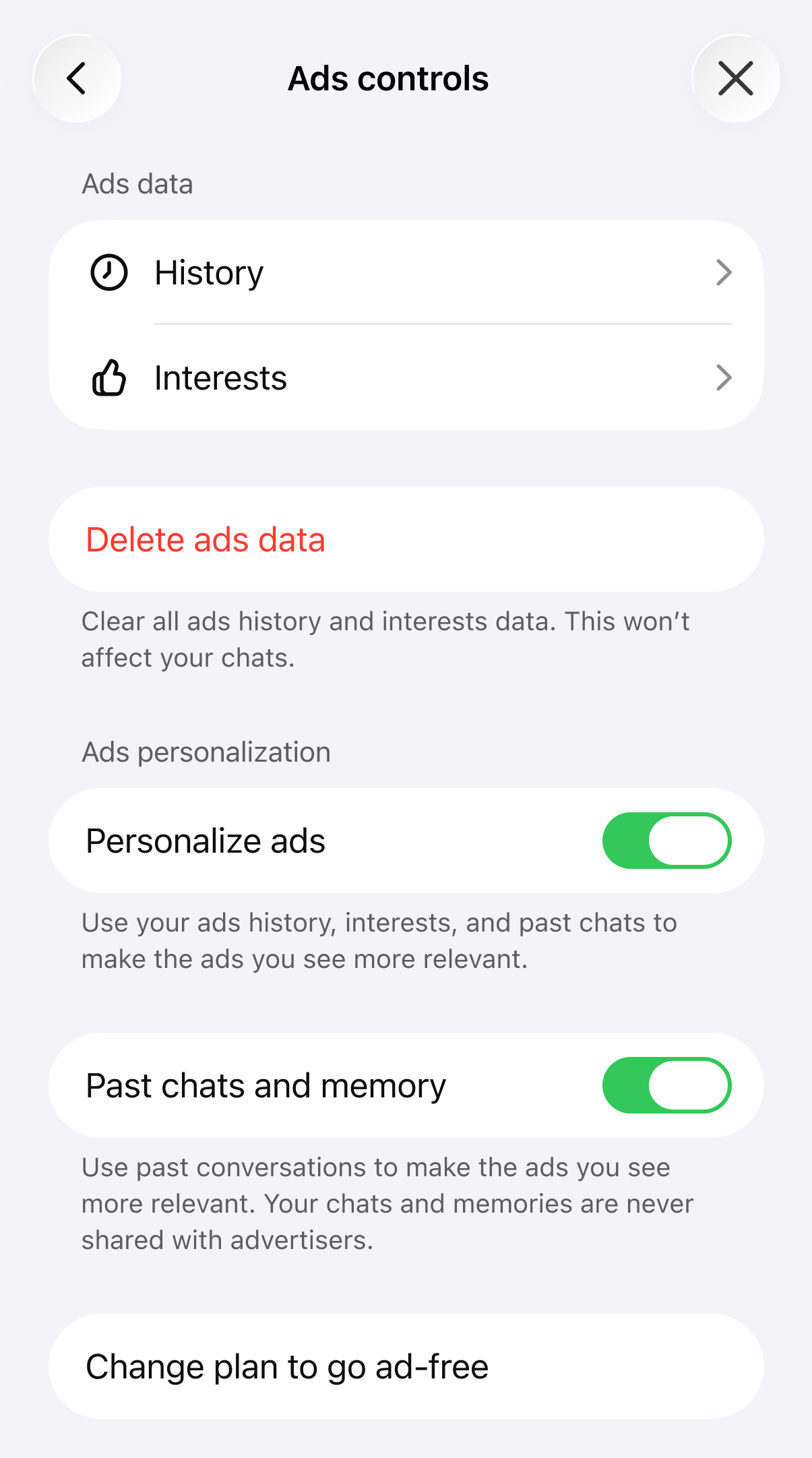
ChatGPT users can adjust ad settings directly in the app, including whether their history and interests may be used for ads. Danish ad campaigns must therefore be based on relevance within the conversation rather than on personal data. Source: OpenAI Help Center.
ChatGPT Ads do not automatically generate higher purchase intent than Google Ads. The opportunity lies in the research phase: Danish companies can gain visibility around problems and decision-making situations before the user has formulated a traditional brand search. The value depends on the target audience’s use of ChatGPT, the category’s ad eligibility, the ad’s relevance, and the quality of the landing page.
How much do ChatGPT Ads cost?
ChatGPT Ads are purchased on a CPC or CPM basis. As of August 2026, OpenAI recommends an initial maximum bid of 3–5 USD per click and specifies a default maximum of 60 USD CPM. The Reach objective is purchased on a CPM basis, while the Clicks objective is purchased on a CPC basis.[2]
These amounts are OpenAI’s initial recommendations in beta, not Danish profitability benchmarks. A realistic test budget is determined retroactively based on three figures. The test requires a certain number of clicks or conversions to generate insights. In addition, there is your expected conversion rate and the maximum acceptable acquisition cost. If the budget can only generate a few observations, the test should be considered qualitative learning rather than evidence of the channel’s potential.
What is the difference between ChatGPT Ads, Google Ads, and organic AI visibility?
ChatGPT Ads target conversational research, Google Search Ads target active searches, and organic AI visibility is about being found and cited as a source in AI responses. Each of these three disciplines is driven by its own set of signals and must be measured separately.
| Area of interest | ChatGPT Ads | Google Search Ads | Organic AI Visibility |
|---|---|---|---|
| Primary Situation | Conversation-based research, exploration, and comparison | Active search for a topic, product, or supplier | Being found, understood, and possibly cited in AI responses |
| Control signal | Context, intent, context hints, ad copy, and landing page | Keywords, target audiences, bids, ad assets, and landing pages | Content, Technical Accessibility, Entities, Documentation, and Authority |
| Payment Model | CPC or CPM, depending on the campaign goal | Typically CPC, but there are other targeting and bidding strategies available | No pay-per-click, but an investment in content, technology, and authority |
| Time horizon | Quick activation after approval, but an immature Danish benchmark | A well-established activation platform with a comprehensive history and tools | A longer-lasting structure with greater visibility if the content is selected as the source |
| Important Limitation | Beta, limited market experience, and phased category access | Competition and costs can be high for mature search terms | No guarantee of mention, citation, or placement in a specific answer |
The choice is rarely an either/or situation. ChatGPT Ads should be evaluated in conjunction with your current Google Ads campaign and the work on Organic visibility in AI search. Paid and organic visibility can complement each other, but they must have distinct roles in the overall customer journey.
Start with a learning budget, not a scaling commitment
ChatGPT Ads is a new channel in Denmark, and early international results cannot simply be applied to your market, category, or customer journey. An initial budget should be used to gain insights into relevant conversational contexts, traffic quality, and conversion rates. Scaling should only occur once data shows which specific challenge the channel actually solves better or more cost-effectively than the alternatives.
How do you get started with ChatGPT Ads?
To get started with ChatGPT Ads, create and verify an advertiser account at ads.openai.com. Next, build your first campaign around a specific decision-making situation. The seven steps below cover the process from category review to launch.
Create an advertiser account: ads.openai.com · Guide to Setting Up an Account · Quick Start: Launch Your First Campaign · OpenAI's Advertising Policies
Determine whether the category is eligible for advertising
In the early stages, OpenAI is prioritizing, among other things, consumer goods, local services, travel, experiences, digital products, and education. Several regulated or sensitive categories are restricted or prohibited, and the rules may vary by market. Check your ad text, images, offers, and landing page against the current ad policies.[5]
Define the pilot's business questions
Choose one clear question that the test should answer. This could be whether ChatGPT can generate qualified traffic during the research phase, whether the channel can open up a new target audience, or whether it can supplement expensive Google searches. Avoid mixing reach, traffic, and direct sales into a single success metric.
Create and verify your Ads Manager account
Designate one account owner, enter your business and account information, complete the verification process, add a logo, set up a billing profile and payment method, and then invite the relevant colleagues. Approval may take some time because OpenAI processes applications on an ongoing basis.[4]
Build the campaign around a decision-making situation
The campaign defines goals, budget, dates, and targeting. An ad group groups ads around a specific theme or area of interest. In the context hints, describe the situations, questions, and criteria where the offer is actually useful. Don’t just write a list of broad product keywords.
Customize the ad and landing page to fit the context
The ad’s headline, text, image, and destination are all factored into the relevance assessment. The landing page should therefore continue the task the user is currently performing, rather than sending everyone to a generic homepage. Use verifiable promises, a clear brand identity, and a call to action that matches the user’s level of engagement.
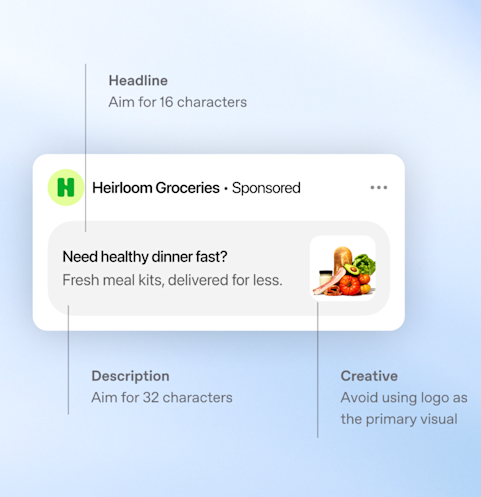
Ad elements in ChatGPT Ads: headline, description, and creative image. Source: OpenAI Help Center.
Set up metrics before launch
Add UTM parameters, set up conversions, and verify technical tracking before the campaign goes live. ChatGPT Ads supports OpenAI Pixel, the Conversions API, and third-party integrations for conversion tracking.[1]
Launch on a small scale and expand based on proven insights
Start with a few target areas and a limited number of ad variations. First, evaluate delivery and traffic quality; then, evaluate conversions and cost. Compare with relevant control channels, but don’t expect the same attribution or volume across platforms.
What features does OpenAI Ads Manager have?
OpenAI Ads Manager is the advertising platform behind ChatGPT Ads and brings together campaign management, conversion tracking, product feeds, audiences, change history, billing, and user management in ads.openai.com. The platform is in beta, and its features are being expanded on an ongoing basis.[7]

Campaign structure similar to that of established advertising platforms
Campaigns in OpenAI Ads Manager follow the hierarchy of campaign, ad group, and ad. A campaign defines objectives, budget (daily or total), dates, and countries, and can be targeted to the iOS, Android, and web platforms. There are three bidding models: CPM for reach, CPC for clicks, and oCPC, which optimizes for measured conversions.[8]
The menu in OpenAI Ads Manager (beta), August 2026. Screenshot taken by the author.
OpenAI Pixel and Conversions API
Conversion tracking is done through a data source using OpenAI Pixel, the Conversions API, or both. The click signal oppref is added to the landing page URL, and advanced matching can improve attribution using SHA-256-hashed customer data.[9]
Our Own Customer Lists as Target Audiences
Custom audiences are built from uploaded lists of email addresses or phone numbers and require a minimum of 25,000 matched users. The lists can be used for inclusion, exclusion, and bid adjustments ranging from 0.1x to 10x at the ad group level.[10]
Ads from the product catalog
Product feeds are uploaded as CSV/TXT files, hosted URLs, or via SFTP, and generate ads featuring product images, titles, prices, and brands on a large scale. Items in the feed expire after 2 weeks, so automatic updates are recommended.[11]
Change history, users, and billing
OpenAI Ads Manager also includes a change history, user and permission settings, API keys, and billing, so that multiple colleagues can work securely within the same advertiser account.[7]
How do you measure the effectiveness of ChatGPT Ads?
OpenAI Ads Manager reports impressions, clicks, spend, CTR, average CPC, average CPM, and conversions once conversion tracking has been set up. Conversion tracking supports OpenAI Pixel, the Conversions API, and third-party integrations.[1] Integrate reporting with UTM parameters and your own analytics tool so that platform metrics can be compared against business goals.
InboundCPH’s pilot model for ChatGPT Ads breaks down a test into four pilot objectives: reach, qualified traffic, conversion, and cross-channel impact. Each pilot objective has fixed metrics and a single decision that the test must lead to. The pilot model prevents a new channel from being evaluated based on a single random number.
| Pilot Goals | Key Metrics | Decision After the Test |
|---|---|---|
| Range | Impressions, CPM, delivery reliability, and relevant contexts | Can the target audience be reached to a sufficient extent and in appropriate contexts? |
| Qualified traffic | Clicks, CTR, CPC, Engaged Sessions, and Landing Page Behavior | Does the traffic match the problem and the level of maturity the campaign is designed for? |
| Conversion | Conversion rate, CPA, qualified leads, or contribution margin | Does the channel generate business value under the agreed financial terms? |
| Cross-cutting impact | Assisted conversions, subsequent brand searches, and channel overlap | Do ChatGPT Ads play a role earlier in the customer journey, even when the last click occurs elsewhere? |
Compare the results with relevant control channels, but don’t expect the same attribution or volume across platforms. Evaluate both direct results and the channel’s potential role earlier in the customer journey—for example, through assisted conversions and subsequent brand searches.
When does ChatGPT Ads make sense?
ChatGPT Ads are most effective when your product or service requires research, comparison, or explanation; when the category is eligible for advertising; and when you can measure more than just clicks. This channel rewards offers that play a clear role in the user’s decision-making process.
- You can describe specific conversations and decision-making situations in which the program is helpful.
- Your category is permitted, and the claims made in the ad can be substantiated.
- You have landing pages that cater to different needs rather than a single generic destination.
- You can measure more than just clicks and distinguish between traffic, lead quality, and business results.
- You have a set learning budget and an agreed-upon policy for continuing, changing, or stopping.
ChatGPT Ads may not be the best choice if your category is limited, if the customer journey rarely begins with digital research, or if measurement isn’t in place. In those cases, investing in established channels or in the overall digital marketing strategy be a better first step.
Frequently Asked Questions About ChatGPT Ads
Can advertisers influence ChatGPT's responses?
No. OpenAI states that ads are displayed separately from the response, and that advertisers cannot influence, rank, or alter ChatGPT’s responses. An advertiser purchases a spot below the response, not a mention within it.
Which industries can advertise on ChatGPT?
In the early stages, OpenAI is prioritizing, among other things, consumer goods, local services, travel, experiences, digital products, and education. Several regulated or sensitive categories are restricted or prohibited, and the rules may vary by market.
Do ChatGPT Ads work in Danish?
Yes. The delivery is based, among other things, on the language of the conversation and the user’s approximate location, so that Danish advertisers can reach Danish users in Danish conversations. Personalized ads are not available in the EEA during the initial phase.
Will ChatGPT Ads Replace Google Ads?
No. Google Search Ads target explicit searches based on established keyword and bid signals, while ChatGPT Ads are matched based on the context and intent of the conversation. The channels can complement each other, but should have separate goals, budgets, and metrics.
Find out if ChatGPT Ads fit into your channel strategy
We’ll help you define a pilot program, set up the metrics, and evaluate ChatGPT Ads alongside Google Ads, AI visibility, and your other channels.
Sources and Further Reading
- OpenAI: ChatGPT Ads Expands Across Europe
- OpenAI Help Center: Ads in ChatGPT – The Basics
- OpenAI Help Center: Ads in ChatGPT
- OpenAI Help Center: Ads Manager Beta Account Setup
- OpenAI: Advertising Policies
- OpenAI Help Center: Quick Start – Launch Your First Campaign
- OpenAI Help Center: Ads Manager Beta Overview
- OpenAI Help Center: Create Campaigns for ChatGPT
- OpenAI Help Center: Conversion Measurement
- OpenAI Help Center: Set Up Custom Audiences for Your Campaign
- OpenAI Help Center: Create Campaigns from Product Feeds