

Executive Brief · 2026
Here's how your business will be recommended when customers ask an AI assistant
Your potential customers no longer just turn to Google to find a solution, a product, or a supplier. They ask an AI assistant for a recommendation. Only a few are mentioned by name. The question is, is yours one of them?.

01 · The Market
The decision has been moved away from Google
Your customers are making more and more of their decisions during an AI conversation before they visit a website or speak with a salesperson. This is the biggest change in the customer journey since Google was launched in 1998.
It's no longer just about being found. It's about being recommended.
02 · The Value
The value lies in the shortlist, not in the click
The supplier that wins a B2B deal is on the buyer’s shortlist from day one in 95% of the cases. In four out of five cases, it is the supplier that the buyer had already preferred before the actual purchasing process began.
If the shortlist is generated by an AI assistant and you aren't mentioned, is We've already narrowed down the options before the shopping trip has even really begun.
That’s why it’s a mistake to measure AI by traffic. AI rarely generates traffic. It builds the shortlist from which selections are made. This is a matter for senior management, not just a task for the SEO team.
03 · The Objection
«AI accounts for 1% of our traffic»
That's the objection we hear most often. It's logical, but wrong, because it's counting in the wrong place.
The decision is often made within the AI response itself. Afterward, the user switches over to Google and searches for your name, product, or solution, and it Clicks are recorded as direct traffic or SEO traffic. The role of AI is becoming systematic underestimated, because your analytics can't detect that the change has taken place.
You measure the shadow and overlook what casts it.
04 · Timing
The most expensive option is to wait
AI models mention the brands they’ve seen mentioned the most times. This gives the first-mover a head start that grows on its own: the longer a competitor has been the AI’s default response, the more entrenched it becomes, and the more expensive it becomes to take its place.
AI visibility isn't a channel you can simply turn on or off when you have time. It's a position that should be built now, while others are waiting.
05 · Evidence
From Invisible to Number 1
Ask ChatGPT or Google’s AI who can provide an interim CFO, and Azets comes up first. A year and a half ago, they didn’t.
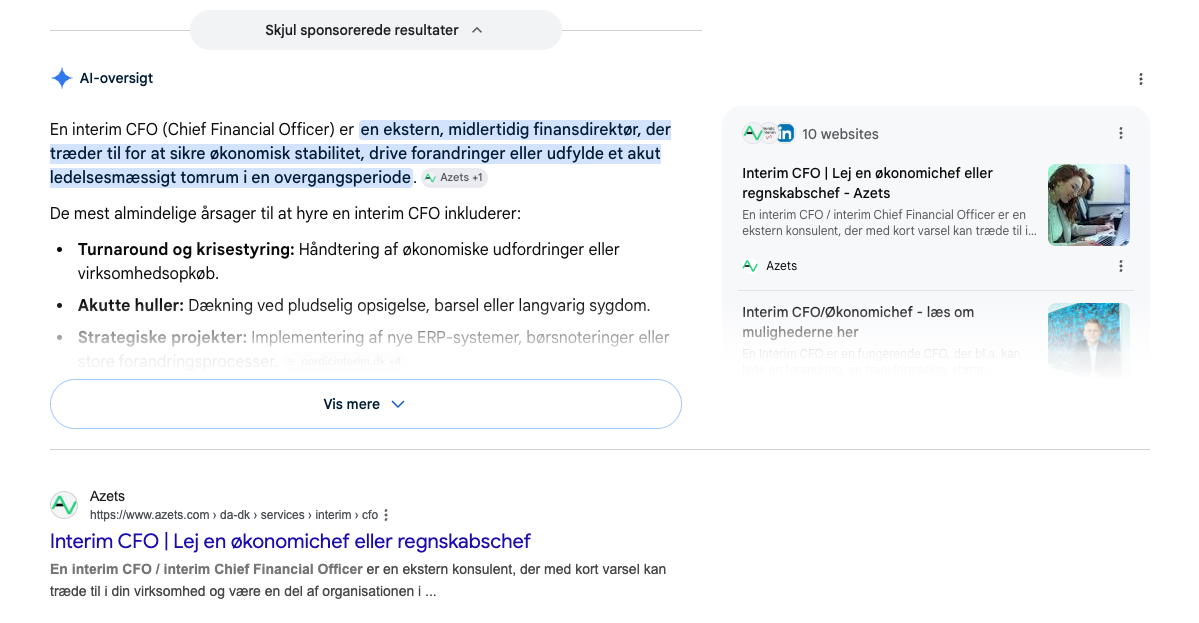
«We've never seen such a massive increase in traffic and qualified inquiries.»
06 · The Method
You must not start over
AI visibility is a five-part process that we manage as a single, integrated workflow:
- 01The entity. The AI's image of you must be accurate and complete.
- 02The intention. The semantic analysis of what your customers actually want to know and how they phrase it.
- 03The answers. Content creation for web pages that a model can quote directly.
- 04The Authority. Mentions in the sources that the models rely on.
- 05The measurement. Your share of AI responses, tracked month by month.
The foundation is the SEO you’ve already built. On top of that, we’ll add what gets you mentioned and recommended.
Go in-depth
Would you like to read more?
Our in-depth white paper explains the method in full detail, from its technical foundations to measuring your visibility in AI responses.
07 · Implementation
What it requires of you
You don't need to build a new feature from scratch. AI visibility is built on top of what you already have and relies mostly on our expertise, not yours.
First measurable SoV movement in 3–4 months. Clear position in 5–7 months.
Rarely a new budget. An expanded, prioritized effort rooted in your existing SEO budget.
Keep moving forward with your team while we handle the specialized work. Or let us help your in-house team build their skills along the way.
No technical barriers and no new platforms. It integrates with your CMS. Measurement takes place in InboundCPH AI-SEO Tools.
From Launch to Initial Results
Typical progress. The exact pace depends on your starting point and the competition in your category.
08 · Integration
A layer on top of the entire marketing engine
AI-SEO doesn’t replace any of your current disciplines. It works in tandem with the marketing engine you already have. Some of your efforts boost AI visibility, while others are boosted by it, and in many cases, it works both ways.
The same content foundation. AI-powered work also improves your traditional rankings. Two benefits from a single effort.
When a buyer has already been recommended to you in an AI response, your brand searches increase, and paid clicks convert better. The buyer already has a preference. This improves the quality of traffic and lowers the cost per conversion.
The models rely on mentions outside your own site. PR and AI-SEO reinforce each other: earned mentions become the signal the models use for training.
Visibility and engagement on social media platforms build the recognition and buzz that models capture. In turn, your AI visibility provides content and insights worth sharing.
09 · Measurement
We measure whether you are recommended
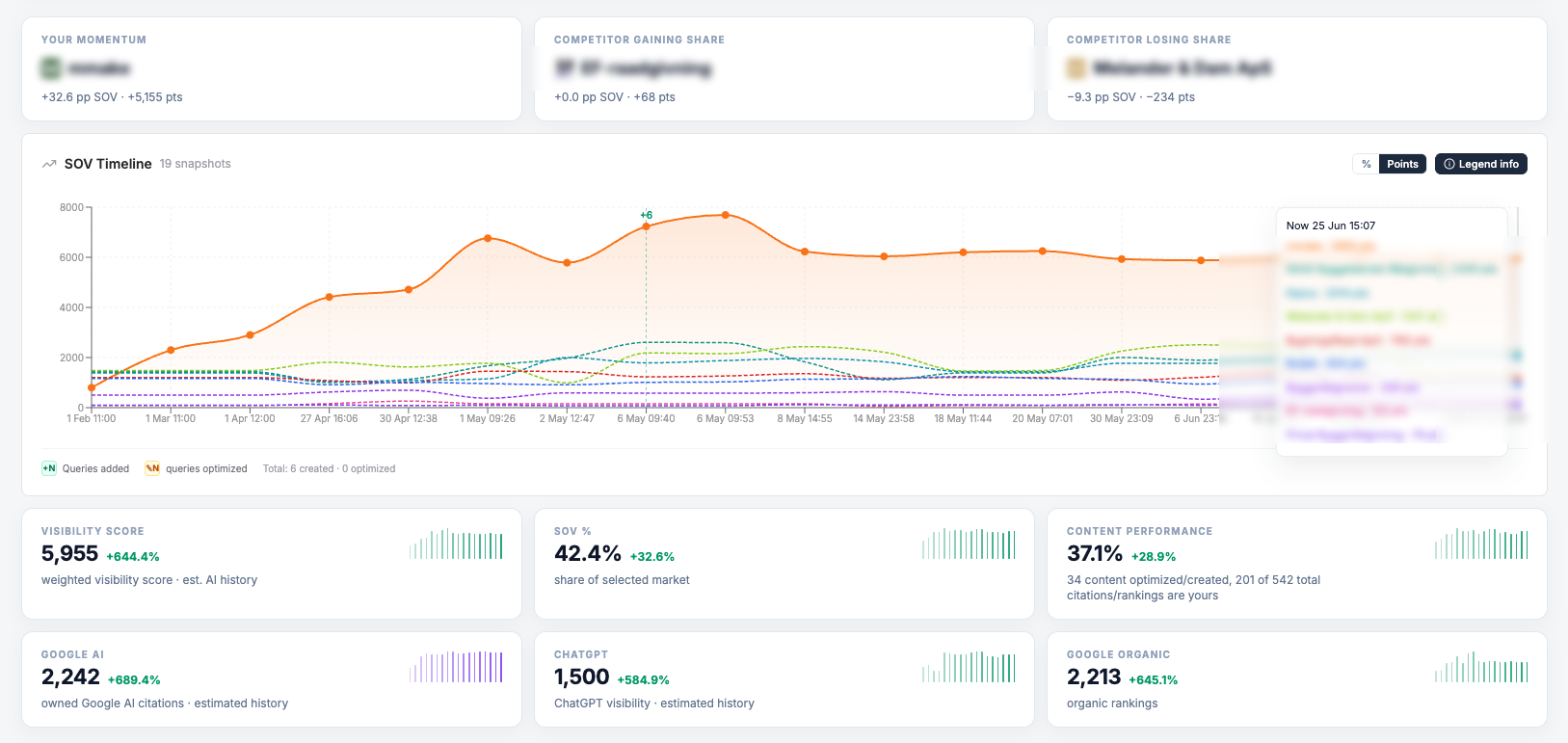
AI visibility isn’t just a gut feeling. We measure your Share of Voice: what percentage of the response landscape (the citations that AI draws on) you account for in your category, and how often you’re mentioned, compared to your competitors and tracked over time.
10 · Risks and Pitfalls
What You Need to Keep an Eye On
We need to be honest about this. Here are the real risks and how we’re addressing them.
Rankings change rapidly, and a position can shift with an update. That’s why we rely on sustainable signals rather than gimmicks: the correct entity, authority, and citable content. And we monitor your Share of Voice on an ongoing basis so we can make timely adjustments and ensure continuous value.
A model might refer to you incorrectly or in the wrong context. We correct the information at the source, monitor how and in what tone you are mentioned in AI responses, and take action when something is wrong.
Looking for a single answer on a single platform on a single day. Answers vary. We manage the portfolio and the trend over time, not a single snapshot in time.
Our goal is simple: to make sure you’re the first name AI mentions when your customers ask. Visibility is something you can influence and measure. And the sooner you get started, the bigger your lead will be—and the harder it will be for others to catch up.
Next steps
Find out where you stand in the AI responses
We offer a no-obligation AI SEO audit. It’s an analysis of your visibility in AI responses within your specific category: how often you’re mentioned, who’s leading the conversation today, and where the first wins lie. It costs nothing and gives you an honest picture.
Sources
Documentation
- 6sense, B2B Buyer Experience Report 2025 (approx. 4,000 B2B buyers, globally): 94% uses AI in the purchasing process; the winner is on the day-one shortlist in 95% of cases; the favorite before initial contact wins approximately 80%.
- SparkToro / Similarweb, 2026 (U.S.): 68% of Google searches result in no clicks, up from 60% in 2024.
- Adobe Analytics, May 2026: AI-referred traffic to retail converts 54% better than non-AI traffic.
- Eurostat, December 2025: Denmark has the highest adoption rate of generative AI in the EU, at 48.4% of people aged 16–74 (EU average: 32.7%).
- Google I/O, May 2026: Google AI Mode surpassed 1 billion monthly users; «the era of Search agents.».
- OpenAI / Reuters, 2025; Sensor Tower, 2025–26: ChatGPT reached approximately 800 million weekly users, and AI assistants are among the fastest-growing apps—which is why shoppers are now turning to AI for answers.
- Ahrefs, May 2025 (75,000 brands): Brand mentions outside a brand’s own website correlate more strongly with visibility in Google AI Overviews than backlinks (0.66 vs. 0.22). Correlation, not causation.
- Azets' number Documented by InboundCPH.