

What is SEO for B2B?
B2B SEO is search engine optimization tailored to companies that sell to other companies. The foundation is the same as the basics of SEO: making your business visible in search engines and AI assistants such as ChatGPT, Perplexity, and Gemini. But the context is different, and that changes both what you’re optimizing for and how you measure whether it’s working.
The difference lies in the purchasing process itself. When a company selects a supplier, it’s rare for a single person to make the decision alone. There’s a subject matter expert, someone who monitors the budget, and often a management team that must approve the decision. The procurement process spans weeks or months, and the contract value per customer is high. That’s why there aren’t many people searching for these opportunities. A technical search term might reach a few hundred people a month, and each of them is genuinely interested.
That shifts the focus. B2B SEO isn’t about driving as much traffic as possible, but about being there when the right professionals are researching a solution. And that research begins long before anyone picks up the phone. By the time a professional recognizes a problem, reads up on it, and compares options, the list of suppliers is often already compiled before you’re even contacted. If you’re not visible during that phase, you won’t make the list. That’s the discipline the rest of this guide is all about: how to be found by the few who matter.
The Difference Between B2B and B2C SEO
SEO for B2B and SEO for B2C are based on the same technical foundations, but they serve two different purposes. The difference is most evident in four areas, and these are what shape how we create content.
Fewer, but more valuable, searches
A B2C company can generate thousands of searches per month for a single product term because it appeals to a broad group of consumers. In B2B, the picture is different. The keywords are more niche and industry-specific; fewer people search for them, but each search comes from someone who is actually considering an investment. So low volume doesn’t mean low value. The value lies in the relevance and in how close the search is to a decision.
More decision makers
A consumer often makes the decision on their own and quickly. A B2B transaction typically involves multiple decision-makers—an entire procurement team—in which a subject matter expert, a finance department, and senior management each evaluate the solution from their own perspective. The content must therefore appeal to both the subject-matter expert and the financial decision-maker on the same page.
Longer and more complex
While a consumer purchase can be impulsive and completed in a matter of minutes, a B2B decision often spans weeks or months of research, comparison, and internal approvals. This requires content that covers the entire process, not just the moment when someone is ready to buy.
Qualified leads over traffic volume
In B2C, the focus is on traffic and sales. In B2B, the focus is on qualified leads and the sales pipeline, because a single contract can be highly valuable. That’s why we evaluate a B2B campaign based on whether the right companies find us and reach out.
Understand the decision-makers behind the search
In B2B, it’s rare for just one person to make a purchase. Behind a search is usually an entire procurement team—a decision-making unit—where each role is looking for something different. This is one of the most important reasons why B2B search must be approached differently than consumer sales.
In practice, there are typically three roles involved. The business user is the person who will be working with the solution on a daily basis. The technical evaluator must assess whether the solution meets requirements, integration needs, and specifications. And the financial decision-maker is responsible for managing the costs and risks. They often attend the same meeting, but they each arrive there by different paths.
The three roles search differently because they have different questions. The business user searches for the problem itself and looks for a better way to solve a specific task. The evaluator searches for features and requirements and wants to know if the solution can do what’s needed. The decision-maker searches for value and risk and asks what benefits it offers and what could go wrong.
For you, this means that your content must cover the entire spectrum—from “what exactly is the problem” to “why choose you as a supplier.” If you focus on only one of these aspects, you’ll lose the other two somewhere along the way. Our specific recommendation is this: Identify your decision-makers, write down the questions each of them asks throughout the process, and create content that answers them. This mapping is a natural part of a well-thought-out SEO strategy, and it’s essential for aligning your keywords with the stages buyers go through.
Keywords associated with the long-tail purchase journey
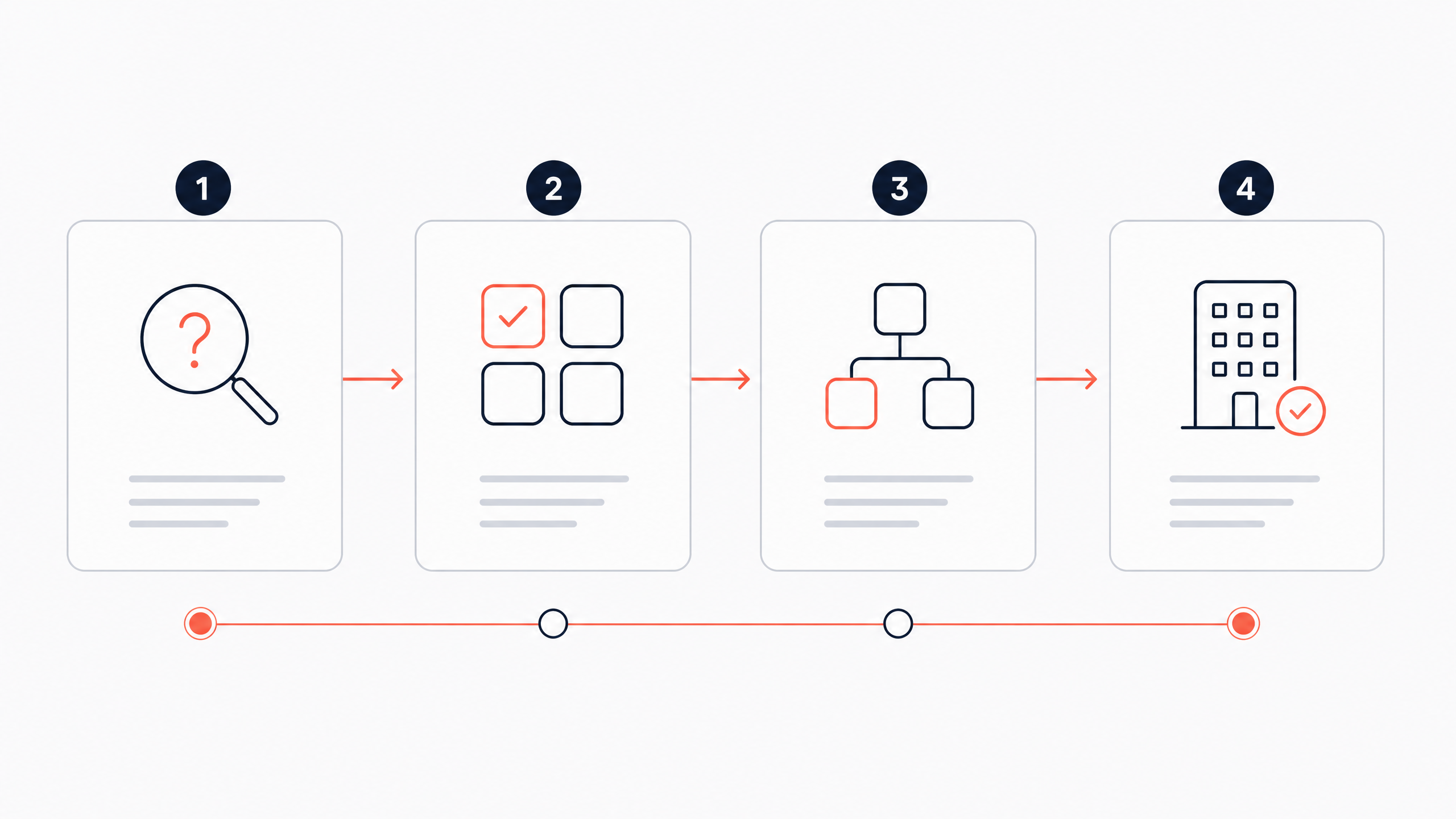
B2B keywords are distributed along a buyer’s journey that often spans months. At the bottom of the funnel are the “ready-to-buy” searches, where a decision-maker already knows what she needs and is looking for a specific solution or supplier. At the top are broad, problem-oriented searches, where it’s too early to talk about products, and where the buyer is simply trying to understand their own problem. When we work with B2B SEO, we map out the entire journey so that the content meets the buyer at every stage of the process.
This progression can be described in four steps. First, someone looks for a way to solve a problem without knowing the category of solutions. Next, the search narrows down to a specific type of solution. Then it becomes more specific and focuses on a particular tool or procedure. Finally, the buyer looks directly for a supplier or agency to handle the task. Each stage requires its own type of content, ranging from explanatory guides at the top to targeted solution and provider pages at the bottom.
The interesting thing about B2B is that the most valuable searches are rarely the ones with the highest search volume. A search that reaches a buyer who is close to making a decision has high commercial value and is also the one that most often leads to an actual inquiry. That’s why we prioritize based on search intent and conversion likelihood, not volume.
In practice, we evaluate each keyword along four axes before determining whether it ranks high or low on the list:
- Commercial relevance: Is the search related to a service, a problem, or a category that you actually want to and can win?.
- Decision-making phase: Does the search focus on understanding the problem, selecting a solution, making comparisons, or choosing a supplier?.
- Contest: How difficult it is to gain visibility for that keyword, and what types of pages are already ranking highly.
- Business value: The search can be linked to contract value, margin, sales priority, or strategic growth.
A low-volume keyword can certainly be given high priority if it targets a high-value solution or a buyer who is close to choosing a supplier. We cover the entire journey, but we give the highest weight to searches where a buyer is close to making a decision. This prioritization is part of the overall SEO strategy.
Optimizing Your Service and Solution Pages
In B2B, conversions rarely happen on a blog post. It happens on solution pages. This is where a decision-maker lands once the research phase is over and the question has shifted from “what are the options” to “can this specific solution solve our problem.” These pages must therefore do two things at once, and both are difficult. They need to rank for “ready-to-buy” search queries, and they need to convince a reader who already knows quite a bit.
It starts with intent-match. A landing page that’s meant to rank for a commercial search must answer exactly what the search query is asking. From there, it’s all about structure. A clear value proposition at the top, so the reader can immediately see if they’re in the right place, followed by the information a professional buyer is looking for: specifications, evidence, and case studies. And a clear path forward to a conversation, without the page feeling pushy.
The technical reader is not alone. A procurement committee also includes someone who assesses financial and risk considerations. That reader asks different questions, and the proposal should be able to address both sets. In our experience, the strongest solution pages are designed to answer what an evaluator wants to know before they even reach out.
Finally, you’ll link the pages together. Internal linking from your pillar content and guides to the commercial pages directs both readers and search engines to the right place, and that requires a solid technical foundation. We’ll take a closer look at this in the section on technical SEO.
B2B Content That Builds Authority
Authority in B2B is built by creating content that demonstrates that you understand your field better than any other provider. A subject matter expert researching a solution can quickly tell the difference between content written to rank and content written by someone who has actually dealt with the problem. They’ll skim over the former. The latter, they’ll save and share internally.
This is also what Google’s guidelines on people-first content point to. Google evaluates content based on E-E-A-T: Experience, Expertise, Authority, and Trustworthiness. For a B2B company, this means that the content must show who is behind it, what experience they have, and how a claim is substantiated. A thorough analysis by a named expert, complete with concrete examples and documentation, builds the kind of authority that an anonymous overview can never achieve.
SEO for B2B marketing works best in cohesive clusters of content. You bring the central topic together in a comprehensive main page and let supporting articles address the questions the purchasing committee raises along the way. One article answers the broad research question, another delves into a specific sub-issue, and a third compares possible approaches. Together, they provide a comprehensive overview of the topic, so that both professionals and search engines recognize that this is a source of genuine expertise.
This places high demands on the quality of every piece of content. Fifteen thin articles, each targeting a single keyword, have less impact than five in-depth articles that answer decision-makers’ actual questions. Content without substance is neither read, shared, nor cited. This discipline is closely linked to the overall SEO strategy, where content, structure, and prioritization all work in tandem.
Link Building and Authority in B2B
Links from other websites remain one of the strongest indicators that your content is trustworthy. In a B2B context, the source of the link carries extra weight. A link from a trade publication, an industry association, or a credible partner in your own niche conveys a message to both professionals and search engines that ten random links from topics unrelated to your business simply cannot.
That’s why we focus on quality over quantity. We purchase editorial links with real value, where the mention appears in a relevant professional context. We never recommend link networks, PBNs, or bulk purchases of cheap links, because these tactics do not build authority in a niche market, and because Google itself classifies the purchase of links to manipulate rankings as link spam. Manual outreach to third-party media has a success rate close to zero, and we’d rather be honest about that than sell a service that doesn’t work. Topic relevance is what makes the difference. In a niche field, being mentioned by the right sources matters more than gathering links broadly. At the same time, be patient. Link building strengthens the foundation for better rankings over months, not weeks, and only relevant links actually make a difference. If you’d like to dive deeper into this discipline, you can read more about our approach to link building.
Technical SEO and User Experience in B2B
B2B sites often have a more complex structure than a typical B2C store. Service, solution, and product pages coexist, often across multiple levels and departments, and the content has been built up over the years by different teams. This makes technical discipline essential for everything else to function properly. If the right pages cannot be crawled, understood, and found, even the strongest content and the best links will never achieve their full potential.
We typically focus on four key areas, and each one has a concrete impact if it falls short. Crawlability and structure come first, because search engines need to be able to reach the pages that actually generate revenue, and on large sites, this requires active management of what to prioritize and what shouldn’t use crawl resources. Next comes a clear, hierarchical information structure supported by internal linking, so that authority flows from the top-level guides down to the commercial pages that are meant to convert. Structured data helps search engines understand a solution or service page for what it actually is.
Finally, speed and user experience. A professional buyer researching a supplier won’t have the patience for a site that loads slowly or is difficult to navigate. Core Web Vitals and a well-designed UX aren’t just about rankings—they’re about keeping visitors on the site long enough for the content to do its job.
A classic B2B pitfall is gated content. White papers, reports, and webinars are valuable content offerings that can generate leads, but if all the substance is hidden behind a form, search engines and AI assistants have too little text to read, understand, and cite. Often, the best solution is a public, indexable landing page with a strong summary, key points, author, date, and target audience—and a clear link to the full resource behind the form. The form can still be there. The point is that the SEO value shouldn’t be hidden away entirely along with the document itself.
Frequently Asked Questions About SEO for B2B
What is the main difference between B2B and B2C SEO?
The main difference lies in the buying journey and the target audience. B2B buying is a longer process, involves more decision-makers, and focuses on fewer but more valuable leads. B2C buying is often shorter, more impulsive, and measures success based on traffic volume and direct sales.
Why is E-E-A-T important for B2B SEO?
E-E-A-T (Experience, Expertise, Authority, Trustworthiness) is crucial in B2B because decision-makers seek reliable, in-depth information from recognized experts. Content that demonstrates genuine expertise and experience builds trust and authority, which are necessary for earning citations in AI-generated responses and ranking highly in search engines.
How does gated content affect B2B SEO?
Gated content can limit the ability of search engines and AI assistants to read and understand your content, since it’s hidden behind a form. To maximize SEO value, you should consider creating a public, indexable landing page with a strong summary and key points that link to the full resource behind the form.